The war we cannot win
Australia has been marched onto a war footing it cannot win.
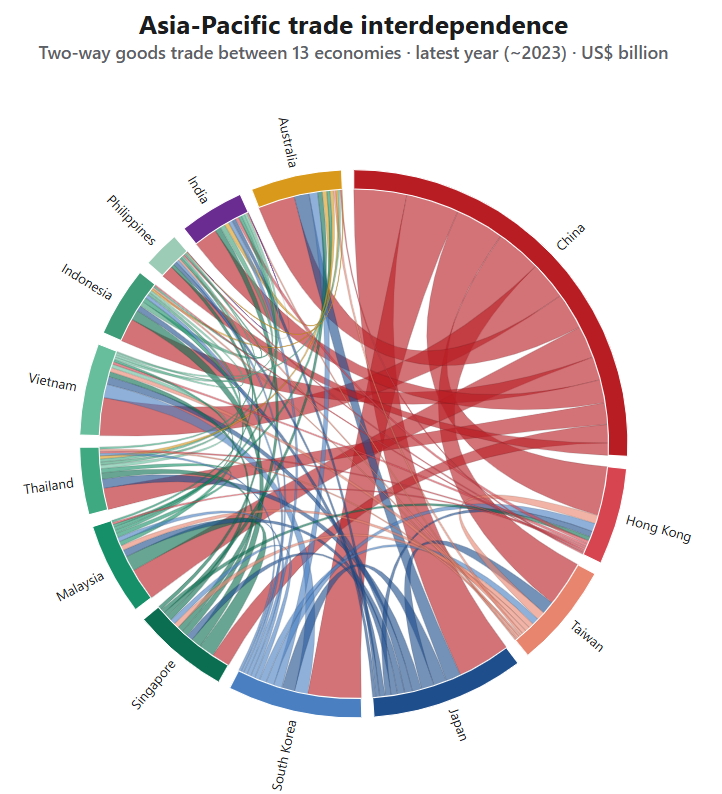
In 2025 the United States renamed its Department of Defense the Department of War — a statement of intent, not a change of stationery. AUKUS chains Australia to that posture: to a confrontation with our largest trading partner, on a timetable set in Washington, for submarines that arrive too late to matter. Strip the politics away and look only at the structure, and the conclusion is unavoidable. This is a war Australia cannot win — because it is not the kind of war that is won by fighting.
The strategic weather, as at July 2026
Yesterday a Chinese ballistic-missile submarine fired a nuclear-capable strategic missile into the Pacific — the first such sea-based launch China has publicly acknowledged, following its 2024 DF-31B ICBM shot near French Polynesia. Australia’s own foreign minister called it “destabilising to the region.” That is the strategic weather Australia actually lives in: a nuclear-armed peer already ranging missiles across the ocean this decade, its submarine leg reaching the continental United States. The answer AUKUS offers is eight crewed boats arriving in the 2040s — a reply to today’s escalation that turns up two decades late, into a war it cannot win.
It is a blockade, and a blockade is won by logistics
The likely China–Taiwan conflict is not an invasion to be repelled. It is a blockade — and a blockade is decided by endurance: by who can keep the ships moving and the fuel flowing longest, not by who lands the first blow. The Proof of the Hormuz Pudding sets out how that contest is actually won. On that measure Australia is not strong. It is the most exposed advanced economy on earth.
Logistics is exactly where Australia loses
Australia imports roughly 90% of its refined fuel — on foreign-owned, foreign-crewed ships, through chokepoints thousands of kilometres from any Australian base — and holds about 30 days of diesel onshore, the only IEA member never to meet the 90-day standard. The war is decided by logistics, and logistics is precisely where the country is weakest. You cannot escort an economy with eight submarines. America First, Australia Loses runs the net assessment in full: even if the United States wins its war with China, Australia loses it.
We are not guessing — 2026 already proved it
In 2026 the closure of the Strait of Hormuz halted about a fifth of the world’s seaborne oil for months, and not even the United States Navy could reopen the strait by force. The economies that kept moving were the ones that had built reserves and refining in advance — the story told in How China Held the World Up. A sea-lane war is survived by preparation, not by joining the fight.
And the weapon does not work as advertised
The AUKUS boats are a new three-nation design, enlarged beyond their parents, to be built in a shipyard that does not yet exist — while the US cannot build the submarines it already owes and the UK’s fleet sits idle. The engineering case is on the record in Building the Sub to Nowhere. The bill is $368 billion for the wrong capability, with the power to decide when it is used handed to Washington — the full reckoning is in The AUKUS Cost Blowout. What Australia commits to spending if it simply stays this course is set out in Without MMA.
And the ally will not save you — it says so out loud
Washington has a catchphrase, and it means exactly what it says.
America First — Australia last.
Under “America First,” Australian exports have been tariffed regardless of the alliance — a baseline duty lifted to 15%, with 50% on steel and aluminium and a threatened 200% on pharmaceuticals, and no exemption granted. The revised AUKUS deal turned Australia’s promised boats into second-hand US hulls, with a statutory clause letting a US president withhold the transfer altogether if it would weaken the American fleet — capability contingent on the patron’s need. And the 2026 US National Defense Strategy quietly stopped calling the Indo-Pacific the priority theatre, tilting toward the Western Hemisphere. None of this is bad faith; it is simply what a great power does — it puts itself first, and folds its allies’ interests into its own. The full net assessment is America First, Australia Loses; the price already paid is counted in The AUKUS Cost Blowout. A country that plans its survival around a patron’s self-interest has no plan at all.