A pillar of the movement · Under Energy

Electricity

The arid interior has the highest solar resource of any developed country. Sub-10c/kWh delivered consumer power. 1,000+ GW of desert solar. 40 GW of firm dispatchable pumped hydro at Alice Hub at 770 m head. The cheapest sovereign electricity in the developed world.

In parliament — Sunshine Australia Party Power Prices — 10c/kWh — the party policy that carries this plan →
Electricity — MMA Energy figure
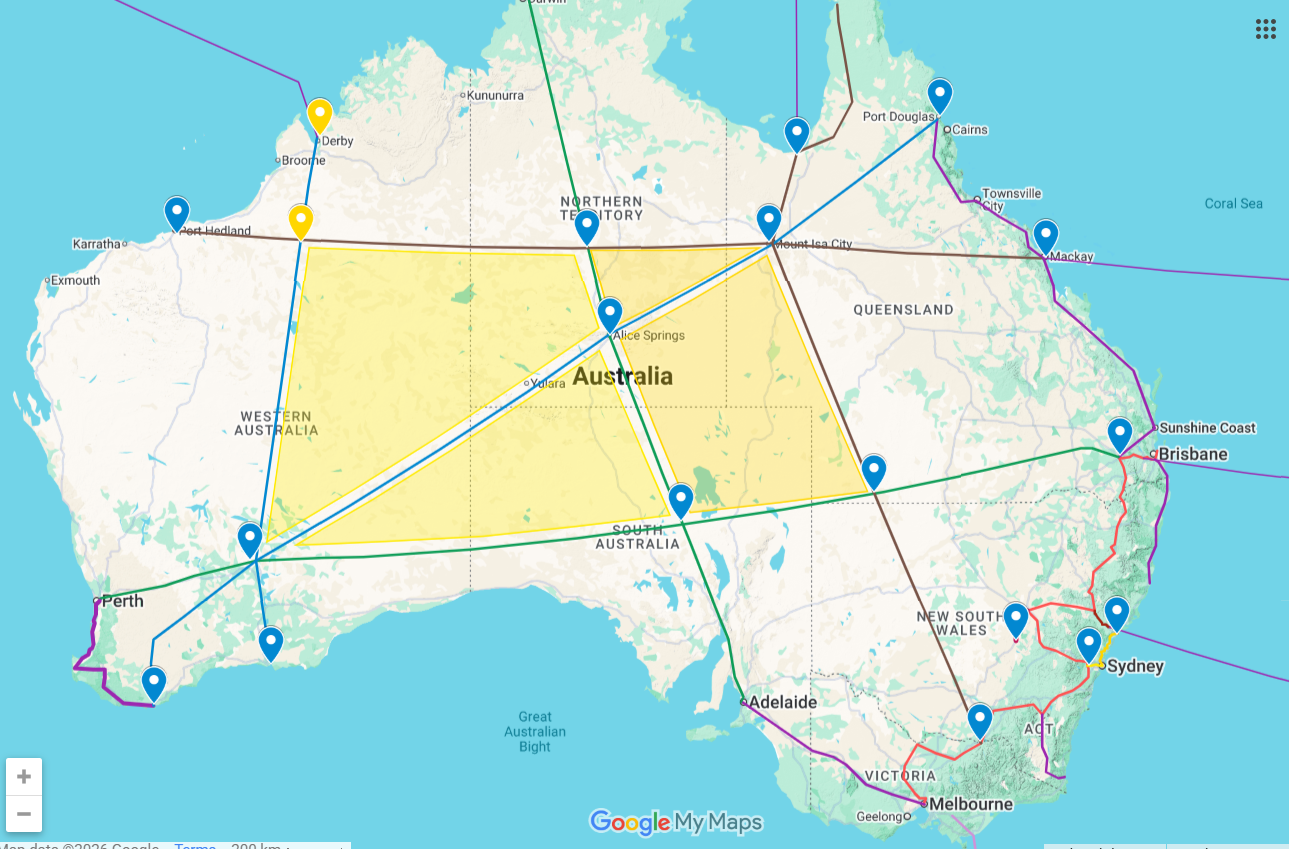
The continental network — desert generation, HVDC transmission on the corridor, and storage at Alice Hub.

One target governs this whole pillar: delivered power under 10 cents a kilowatt-hour. Not wholesale, not generation cost — the number on a bill. Everything below exists to reach it, because at 10 cents an electric vehicle is about nine times cheaper to run than a petrol one, industry becomes competitive again, and every fuel this country imports starts being replaced by something generated here.

Cheap generation is not the hard part. CSIRO puts the current national pathway at 14 to 15 cents delivered including transmission and before distribution charges — because generation is only about a third of a household bill and the network is most of the rest. Australia's problem is not the price of a solar panel. It is that the wires to move the power do not exist, and building them is the slowest, most contested thing in the energy system.

Link the grids

The corridor carries high-voltage direct current in an easement already being cut for freight, water and fibre, which is what makes continental transmission affordable at all. Joined up, the state grids stop being islands. And because the continent spans about three hours of time zones, the eastern evening peak lands in the middle of the Western Australian afternoon — western sun serving eastern dinnertime, eastern morning serving the western sunrise. That three-hour arbitrage is generation the country already has and currently cannot move.

Use everything

The test is a price, not a fuel. Desert solar at 1,000-plus gigawatts of potential, wind where the resource is good, coal running until it is undercut on cost rather than closed to a date set in a capital city, and gas for firming. Nothing is retired to meet a target; things are retired when something cheaper replaces them, which is the only way an energy transition has ever actually happened.

Build it in the desert, not on farmland

Where the generation goes decides whether it gets built. The transmission and renewable projects stalled in the eastern states are stalled because they run through productive farmland and the communities on it — and those fights are legitimate, because prime agricultural country is not spare land.

The interior is. It carries roughly 2,400 to 2,800 kilowatt-hours per square metre a year against 1,600 to 1,800 in the coastal zones, so the same panel earns substantially more, and it sits on country that displaces no crop, no herd and no national park. Where generation does meet farmland the arrangement is agrivoltaic rather than exclusive — panels raised over grazing and horticulture, with the shade cutting water use — so the hectare keeps producing food as well as power. Put the arrays where nothing competes for the ground, and run the wires down a corridor already being cut.

Store it properly

Batteries do about three hours. That is enough to move a solar afternoon into the evening peak, and it is not enough to carry a week of weather. Alice Hub pumped hydro is 40 GW at 770 metres of head with roughly 30 TWh of storage — on the order of a month of continental supply, against Snowy 2.0’s 350 GWh. Short-duration batteries and long-duration pumped hydro do different jobs; the system needs both, and Australia currently has neither at scale.

AI is the customer that turns up first

Compute is the fastest-growing electricity load on earth, and it is unusually mobile: a data centre goes wherever power is cheap, firm and abundant, because energy is most of what it buys. That makes it the natural anchor customer for desert generation — a buyer large enough to underwrite capacity, and one that wants exactly what this system produces.

Australia’s position is better than it looks. The interior has the resource, the corridor delivers the transmission and the water, the fibre runs in the same trench, and Darwin is about 23 milliseconds from Singapore — close enough to serve the region’s workloads. Inland campuses also solve the cooling problem differently, recovering waste heat rather than fighting it. The full case is on the AI & Compute page.

Then sell the surplus

A continent generating at that scale produces far more than it uses. Seven subsea corridors carry the surplus into a starter market of about 600 million people, and every megawatt-hour exported displaces coal or gas burned by a neighbour. Unlike coal, iron ore and LNG, it does not deplete — the same cable earns for as long as the sun keeps rising on the same desert.
The current path vs the MMA plan.

Cons: the existing system and current trajectory. Pros: the integrated MMA corridor programme.

Cons of the current system & plan

Electricity prices among the highest in the OECD

Australian household electricity prices have tripled over two decades despite abundant solar resources and gas reserves. Industrial customers pay more than competitors in jurisdictions with worse renewable resources. Productivity, manufacturing competitiveness, and household budgets all suffer.

Coal exit strategy is unfunded

Coal generators are aging out of the fleet over the next decade but no integrated national replacement plan exists. The current approach relies on uncoordinated state-level investment and contracts-for-difference that have delivered cost overruns and missed timelines.

No serious firm dispatchable capacity at scale

Snowy 2.0 targets 350 GWh of storage at 2 GW - approximately 7 days of operation. Australian batteries are measured in single-digit GWh. There is no national reserve sufficient for an extended sun-and-wind drought across the continent.

Renewable build is scattered and slow

AEMO’s ISP relies on hundreds of dispersed renewable energy zones requiring new transmission to each site. Community resistance to transmission lines on rural and farming land has stalled multiple major projects. Coordination cost is enormous.

Imported fuel dependency is structural

Australia imports 80-90% of refined fuel and runs approximately 30 days of diesel stock - well below the 90-day IEA obligation. Heavy freight, mining, agriculture, and defence are all dependent on continuous imported fuel.

Nuclear adds 15-20 years to the timeline

The Coalition’s nuclear proposal targets first power in the late 2030s at $250-400 billion plus. Capital cost, regulatory framework, and skilled-workforce ramp are not in place. Coal cannot wait 15 years.

Pros of the MMA plan

The centre of Australia is the solar powerhouse it has always been

The arid interior has the highest solar resource of any developed country — 2,400–2,800 kWh/m2/year insolation across the inland Solar & Farming Zones, with potential to scale generation to 1,000 GW on under 2% of Australia's land area. The corridor brings water to it, takes electricity from it, and turns the underused centre into the engine that powers the whole continent. See MMA Memo 1 — Solar Sizing for MMA: Reaching 1,000 GW.

Sub-10c/kWh consumer power

Legislated under 10 cents per kilowatt-hour, locked in by policy. The cheapest sovereign electricity in the developed world. Manufacturing, households, and EV charging all benefit from the same policy lever.

40 GW firm dispatchable PHES at Alice Hub

32 days of continuous national grid supply at full discharge. Frequency control, black-start capability, baseload replacement - all from one strategic asset. The largest pumped hydro system on Earth, in the location geography already provided.

Eliminates the import-fuel vulnerability

Electrification of freight, transport, and industrial process heat collapses Australia’s diesel and gas import bill - reducing the largest strategic vulnerability the country carries.

One policy decarbonises both grid and transport

Sub-10c/kWh retail electricity makes EVs cheaper to run than petrol cars on every grid, even before the grid fully decarbonises. Both transitions delivered by a single price signal.

HVDC carried on shared infrastructure

72 GW of high-voltage DC transmission rides on the same MMA viaduct as freight, water, and passenger services. No separate easement, no parallel build, no community opposition over new transmission corridors.

Export-ready surplus

Generation capacity scales well beyond Australian demand. Surplus power exports to Asia via HVDC undersea cables and AI compute services create sovereign revenue streams without depleting domestic supply.

The dollar case for Energy

CapexEnergy infrastructure capex sits across multiple corridor systems. HVDC backbone is integrated into the Phase 0 spine ($138–257 B total Phase 0 capex) and extends with the continental phases. Alice Hub PHES storage $29–53 B PHES marginal capex inside Alice Hub total $65–133 B, delivered with Phase 1 when the central engine comes online. Desert PV capacity (~1,000+ GW potential) is bought via long-duration PPAs from industry, not built by MMA, and scales with the continental corridors that link the desert generation zones to load. See Memo 19.
Tier 1 — Direct MMA revenueHVDC electricity export to Asia: $57 B/yr at maturity (locked working figure, 82.5 GW × $80/MWh; conservative case $28 B/yr still substantial). HVDC transmission domestic: $4–6 B/yr from Day 1 of Phase 0.1 (east-coast HVDC trunk on the Phase 0 spine), rising to $12–19 B/yr at full backbone maturity when the continental corridors are online. Carbon credits: $75 B/yr at maturity (working figure, range $30–150 B by carbon price sensitivity). See Memo 20 §2.1, 2.2, 2.8.
Tier 2 — Enabled outcomes and cascading upliftCheap-electricity cascade (Tier 3, not summed): household disposable income +$10 B/yr; EV uptake; real wages; pensioner energy stress retreat; inland services viability. Plus reduced fuel imports retained $30–40 B/yr at maturity (Memo 20 §3.3).
Without MMA — what Australia spends insteadWithout MMA, energy sector commits $312–520 B over 20 years (renewable+storage pathway) or $565–1,040 B (if nuclear pursued): AEMO ISP transmission $115–160 B, firming and storage $87–160 B (at 25× Alice Hub per-kWh cost), continuing energy-price relief and bailouts $110–200 B. Delivers grid capacity to maintain demand at continuing high prices. No HVDC export industry. Memo 21 §3.

Programme-wide ROI summary →  ·  Memo 19 (cost) · Memo 20 (returns) · Memo 21 (counterfactual)