Division or Unity
Australia is building a wall of Pacific treaties designed to lock China out. This one-pager sets out the pattern, the treaty wording that fuels division, China’s competing offer of development — and why MMA’s defence strategy chooses unity, not division.
1. The pattern — a wall of treaties
Since 2023 Australia has moved to lock the Pacific into an exclusive security orbit: the Tuvalu Falepili Union (in force 2024), the Nauru Treaty (2024), the PNG Pukpuk mutual-defence treaty (2025), the Tonga ‘Kaume’a Ofi’ Statement of Intent (2025), and the 2026 defence pacts with Fiji and Vanuatu. Presented as friendship and support, the common thread is strategic: each agreement pulls a Pacific state closer to Canberra and, crucially, limits who else it may deal with.
And the treaties are only the diplomatic half of the wall. The military half is AUKUS — a roughly A$368 billion bet on the same containment logic, dissected in The AUKUS Cost Blowout, Building the Sub to Nowhere and the net assessment America First, Australia Loses. The alternative to both halves is set out in The Prize: A Unified Asia-Pacific.
2. The wording that divides
Read the clauses and the intent is plain. The Falepili Union’s Article 4 requires Tuvalu to mutually agree with Australia any security or defence arrangement with another country — extending to policing, cyber, ports and telecommunications. The Nauru Treaty gives Australia the same mutual-agreement lock over Nauru’s security, banking and telecommunications. These are not clauses of partnership; they are clauses of exclusion. They do not say “let us build together” — they say “you may not build with them.” Wording that hands one power a veto over a small neighbour’s choices fuels division, not unity, and it is aimed squarely at one country: China.
3. China’s other offer
While Australia offers exclusion, China offers construction. Across the region China has built ports, roads, wharves, government buildings, hospitals and sporting complexes, extended development finance, and offered to play a role in the region’s growth — from the Solomon Islands to Tonga’s national sports complex. That engagement carries real debate: questions of debt, transparency and strategic leverage are legitimate, and Pacific governments weigh them carefully. But the contrast in posture is stark — one power arrives with a wharf, a stadium or a development plan; the other arrives with a treaty clause about who you are allowed to talk to. To much of the region, development is the more attractive offer.
4. We lose economically — long before any war
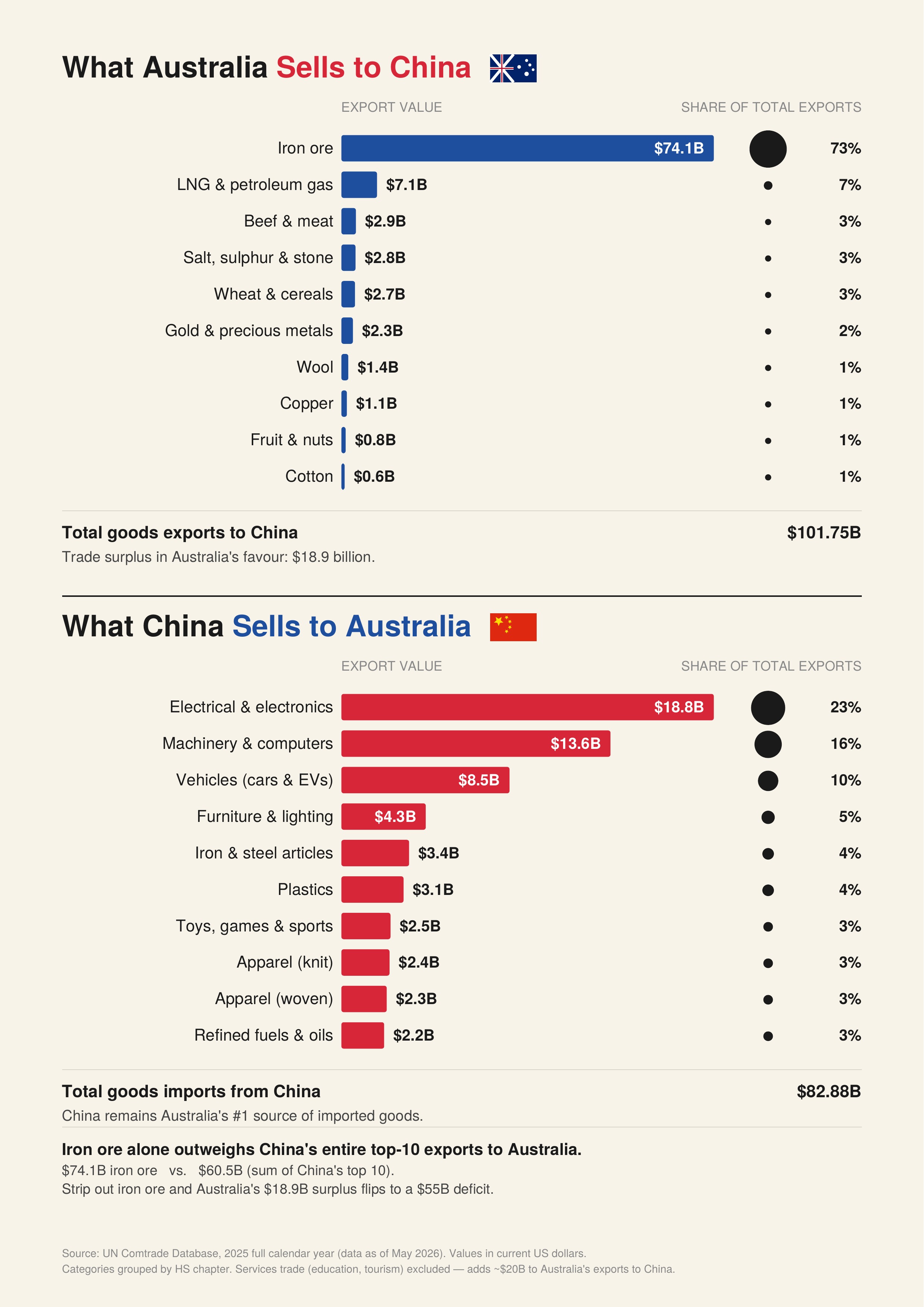
Here is the part the strategy papers skip: China is Australia’s number-one trading partner, and it is not close. Around a third of our exports go to China — iron ore, gas, coal, barley, beef, wine, education and tourism — worth hundreds of billions in two-way trade every year, underwriting Australian jobs, budgets and living standards. Building a wall against our largest customer is not a cost we pay only if war comes; it is a cost we pay first, in peacetime. Australians already saw the preview: between 2020 and 2023 a diplomatic rupture triggered Chinese tariffs and bans that cost exporters billions before the relationship was painstakingly rebuilt. A treaty strategy openly designed to contain and exclude China invites exactly that again — larger, and harder to undo. We would lose the trade, and the prosperity it funds, well before a single shot was fired. A war in the Asia-Pacific cannot be won — but the economic war of decoupling is one we would start losing immediately, and losing to ourselves.
5. Unity, not division
MMA’s defence strategy starts from the opposite premise. A war in the Asia-Pacific cannot be won; the region’s economies are stitched into one another through the same sea lanes and the same trade; and Australia’s security is best served not by walling China out but by helping build a prosperous, integrated, non-aligned region in which every nation — China included — has a stake in the peace. That is the case made in The Prize: A Unified Asia-Pacific and across the Defence pillar. Australia should be the bridge in the Asia-Pacific, not the wall across it.
6. The choice
Every treaty clause that hands Canberra a veto over a neighbour’s future is a brick in a wall. Every wall invites a countermove, and the region fragments into blocs — exactly the conditions that make a war more likely, not less. The alternative is not naïveté about China; it is confidence in a better offer. Meet development with development, build with the region rather than against a rival, and choose the doctrine that actually keeps the peace: unity, not division.
References & sources
- Treaty texts and country briefs: DFAT (Tuvalu Falepili Union; Nauru; Papua New Guinea; Tonga). See also the MMA register What We’ve Been Signed Up To for the full agreement list, the money committed, and primary sources.
- Pacific security agreements and Chinese regional infrastructure/development: reputable reporting and analysis (Lowy Institute, Reuters, ABC, The Diplomat), 2023–26. Interpretation and framing are the author’s.