The AsiaPac Solution
The companion to The AsiaPac Predicament. Its argument is simple: the South China Sea dispute cannot be solved by dividing the sea, because division requires an agreement on sovereignty that will never come. It can be solved by sharing the sea — and that act of sharing can become the founding step of a united Asia-Pacific.
Added Deng Xiaoping’s counsel to “set aside disputes and pursue joint development” — the region’s own largest power having once advocated exactly this approach.
Shares are set by each nation’s frontage on the Union Zone (its circumference), with Brunei floored to 2%; Taiwan’s share is the northern piece drawn from China’s section.
1. The AsiaPac predicament
The companion memo, The AsiaPac Predicament, sets out the situation in full. In short: six nations claim overlapping parts of the South China Sea; the 2016 arbitral ruling settled what the features are worth in law but not who owns them, and it cannot be enforced; and for forty years every attempt at a settlement has failed. The confrontations continue, and with them the risk of a war whose first-year cost would be measured in the tens of trillions of dollars.
The dispute resists solution for one reason: every proposed solution has tried to divide the sea, and division requires the parties first to agree on who owns what. In eighty years they have not, and they will not. A settlement that depends on answering the sovereignty question is a settlement that will never arrive. The way forward is to stop asking it.
2. The solution: a united AsiaPac, starting in the South China Sea
The proposal is straightforward: do not divide the sea — share it. Leave the question of sovereignty unanswered, and turn the contested waters into a zone that every claimant owns together and develops together. And treat that arrangement not as a narrow fix for a maritime quarrel, but as the first act of a united Asia-Pacific.
This is well-proven ground. Antarctica’s treaty froze seven nations’ rival claims, demilitarised the continent and has kept the peace for more than sixty years. Svalbard flies one flag but grants every signatory equal rights to its resources. And the European Union began as a pact between six recent enemies to pool the coal and steel they had most lately fought over — a pooling that grew into a union which has held the peace for seventy years. Closer still to the case at hand, the United Kingdom and Norway settled their North Sea boundary and then, rather than let it divide the wealth beneath, agreed to develop the oil and gas fields that straddled the line as shared units, splitting the output by an agreed formula — a half-century of quiet, productive cooperation that turned contested seabed into common prosperity. Set the quarrel aside, share the wealth, build the institution: it is one of the best-tested moves in modern statecraft. And it is not a move alien to the region’s largest power. Facing these very disputes, Deng Xiaoping counselled that the nations involved should “set aside disputes and pursue joint development.”
The benefits are large, and they fall to everyone:
- Peace. The grey-zone confrontations — the water cannon, the rammings, the standoffs — lose their purpose once the sea is shared. The single most dangerous trigger for a great-power war is removed.
- Prosperity. The oil, gas and fisheries the dispute has frozen in place are unlocked by joint development. Money that now buys coast guards and grey hulls buys production instead.
- Energy security. A region that develops its own sea is far less hostage to distant suppliers and vulnerable choke points.
- Fairness. Every nation’s near-shore waters — and every field already producing — stay wholly its own. Only the distant, contested centre is shared, and it is shared by a rule no one can call rigged.
- An Asian-led future. A settlement built by the region, for the region, owing nothing to any outside power.
The prize is not the reefs. It is peace. Every year the dispute continues is a year of rising risk, rising cost and deepening militarisation in the world’s most important waters. This framework offers the region a way to step off that path — and to build, in its place, the habits of cooperation from which a lasting Asia-Pacific peace can grow. That is what is being proposed here: not merely a way to divide a sea, but a way to keep the peace of a region.
3. The proposal, in detail
The framework has a small number of moving parts, each chosen to be simple enough to explain on one page and objective enough to be hard to argue with.
The 150-kilometre rule. Every nation keeps, in full sovereignty, the sea within 150 kilometres of its coast. This band holds essentially all of the region’s producing oil and gas fields — every one of them grandfathered, left wholly in national hands — so no nation is asked to give up anything it already relies on. Why 150 kilometres? Because it asks every nation to put up the same collateral. A full sovereign claim under the Law of the Sea can reach 200 nautical miles (about 370 kilometres); by keeping 150, each nation sets aside the distant remainder of what it might otherwise claim. That is the price of membership — everyone gives a little of the far water to gain a share of all of it, and it is precisely because the sacrifice is equal and shared that the union is fair. Beyond 150 kilometres — the distant, genuinely contested centre — the sea becomes the shared Union Zone.
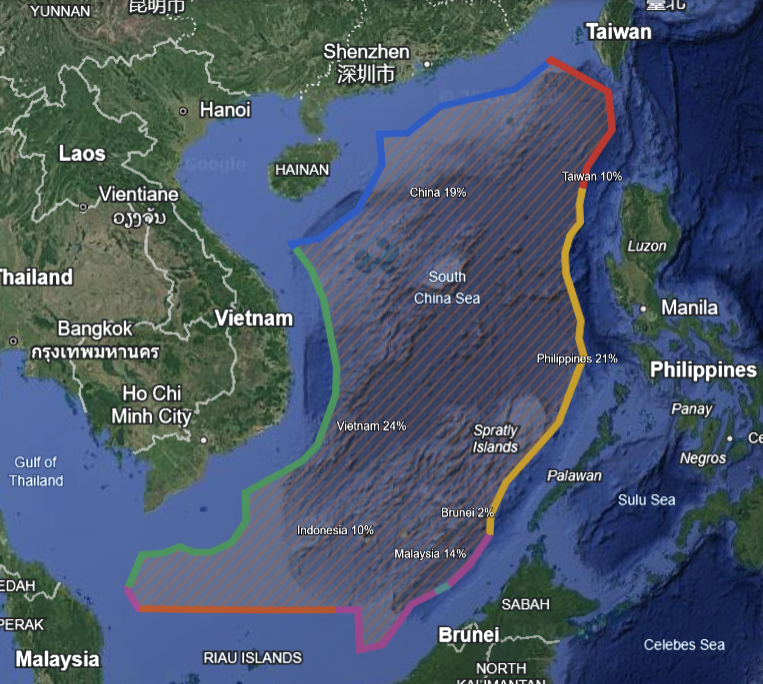
The parties. Six sovereign parties: China, Vietnam, the Philippines, Malaysia, Brunei and Indonesia. China and Taiwan participate as one, consistent with the One-China framework — one seat, one vote, and a single combined share.
Taiwan, and the cross-strait question. The dispute between Beijing and Taipei is a separate matter, and not one this framework exists to settle. Under the One-China framework, China and Taiwan enter the union as a single member: one seat and one vote, and one combined economic share of about 29% — China’s 19% and Taiwan’s 10%. Crucially, Taiwan’s 10% is drawn entirely from the Chinese portion of the zone — the northern stretch nearest Taiwan — so no other party gives up anything to accommodate it; the whole of it comes out of China’s own allotment. How that single seat, that single vote and that combined share are divided between Beijing and Taipei is left wholly to them, and the union takes no position on cross-strait status.
The share of the Union Zone. The Union Zone runs to some 1.65 million square kilometres of shared sea — an area the size of Iran, or of Alaska. Its benefits are divided by the simplest objective measure available — each nation’s frontage on the Union Zone, its share of the zone’s circumference. Your share of the sea equals the share of its edge you hold.
| Nation | Union Zone share |
|---|---|
| China + Taiwan (One China — one seat, one vote) | 29% |
| — China | 19% |
| — Taiwan | 10% |
| Vietnam | 24% |
| Philippines | 21% |
| Malaysia | 14% |
| Indonesia | 10% |
| Brunei | 2% |
Shares computed from real geometry — each nation’s frontage on the Union Zone. Under the One-China framework, China and Taiwan hold a single combined share of about 29%; the split shown between them is internal. Brunei is floored to a 2% minimum as the smallest partner.
Governance. The Union Zone is run by a Council on which every member has one vote, whatever its size — the smallest state equal to the largest. Economic shares follow the table above; political rights do not. A neutral Secretariat handles day-to-day administration, and an independent body resolves disputes with binding authority.
Protecting what exists. Two rules guard current interests. Grandfathering: every field already producing — all of them inside the national band — stays wholly national. Unitization: where a single deposit straddles a boundary, it is developed as one unit and the revenue shared, as the offshore industry already does worldwide.
The legal foundation. This is not a departure from international law but an application of it. The UN Convention on the Law of the Sea, which every claimant has ratified, provides in Articles 74 and 83 that, pending a final boundary, states shall make “provisional arrangements of a practical nature” that are “without prejudice” to the final settlement. This proposal is exactly such an arrangement. No party can reject it as illegitimate without rejecting the convention it has already signed.
The instrument. All of it takes the form of a single binding, ratified, UN-registered treaty — not a declaration, not a memorandum. The failures of the past were failures of form: non-binding statements that changed nothing, and secret bilateral deals that collapsed under scrutiny. A binding, transparent, multilateral treaty is built to avoid both.
4. The wider union: all of AsiaPac
The South China Sea is where the union begins, not where it ends. The logic that makes the sea shareable — set aside what divides, pool what unites, build the institution — does not stop at the water’s edge.
Once the members share the sea and the wealth beneath it, the same machinery extends naturally: agreed freedom of navigation; joint disaster response for a region that lives with typhoons and earthquakes; shared infrastructure and energy links; the lowering of trade barriers. Each step earns the trust for the next. In time the arrangement becomes what Europe’s coal-and-steel community became — a standing Asia-Pacific Union, open to every nation of the region, bound together by shared prosperity rather than held apart by old quarrels.
Europe began with the two commodities six recent enemies had most lately fought over. Asia-Pacific can begin with the sea. The islands and reefs in dispute amount to a few square kilometres of rock; they were never worth a war. Shared, they can be worth something far greater — the foundation of a united, peaceful and prosperous Asia-Pacific.
And what begins with a shared sea need not end there. The same partnership that shares oil, gas and fisheries can go on to share infrastructure and technology — power links, ports, shipping lanes, undersea cables, the tools of a modern economy built and run in common. Each shared project is a strand of trust re-woven. That, in the end, is the true aim: not lines on a map, but the return of trust and friendship among the nations of the Asia-Pacific — and a framework open to grow, welcoming new members across the region until the union is as wide as the Asia-Pacific itself.
Offered as a constructive alternative to a policy of confrontation. Comment and criticism are welcome. Read the companion analysis, The AsiaPac Predicament.