The Asia-Pacific Subsea Corridor Network
Seven subsea multi-service corridors radiating from Australia — the conservative starting set, the industrial base it anchors, and the regional grid it eventually completes.
Subsea corridor network: routes, benefits, deployment timeline.
Seven subsea multi-service corridors connect Australia to seven Asia-Pacific economies covering approximately 600 million people. Combined corridor length: approximately 32,500 km. Each corridor carries HVDC electricity and fibre by default; gas, hydrogen, or water added per destination-nation requirement. Services supplied on separate spools and joined into the corridor by the cable-lay vessel during install. The technology is operationally proven; the political framework is established via the ASEAN Power Grid MoU (October 2025). Network benefits are detailed in Section 4; the Australian industrial base in Section 5; the programme's continuous-deployment structure in Section 6.
| Benefit | Mechanism |
|---|---|
| Grid stability | Bidirectional flow on every corridor smooths peak/off-peak demand across the participating grids. Renewable penetration scales because surplus in one grid exports to deficit in another. |
| Regional grid | Starter network: 600 million people across 7 economies. By 2050 with destination-nation onward extensions: 2–3 billion. Australia as the central node and largest generator. |
| Net zero | Australian renewable electricity displaces destination-nation coal generation. Paris Agreement Article 6 framework (finalised COP29 2024) credits a verified share back to Australia. |
| Pricing | First install of each route includes survey, approvals, landing-station civil works, and consortium engineering as sunk cost. Subsequent installs on the same approved corridor reuse those inputs; unit cost declines per install. |
| AUKUS extended | Subsea corridor delivery uses the dockyards, shipyards, heavy fabrication, and marine workforce that AUKUS commissions (repositioned per Memo 18). Civilian commercial load on the same industrial base. No new sovereign maritime base required. |
| Sovereign industry | Cable manufacturing, vessel fleet, transformer and converter assembly, subsea connectors, install services, lifetime repair fleet. All sovereign Australian, in partnership with named consortium experts. |
| No endpoint | Three independent expansion vectors: capacity per route, routes per region, standard exported to other regions. Australian industrial activity continuous for the rest of the century. |
1. The proposition
Modern Movement Australia proposes seven subsea multi-service corridors radiating from Australia to the Asia-Pacific. Combined length is approximately 32,500 km. Each corridor carries HVDC electricity and fibre by default, with gas, hydrogen, or water added where the destination nation requires them. Services are supplied on separate spools at the manufacturing stage and joined into the corridor by the cable-lay vessel during install — one vessel operation per route, one set of approvals, one consortium engineering programme, delivering the complete service stack to the seabed.
This is the subsea equivalent of the MMA land corridor — one productised install programme, multiple services delivered concurrently, one consortium. The seven routes are the conservative starting set, bounded by what is technically deployable today and what is politically deployable today with destination nations Australia already has working relationships with. Additional install lifts on the same routes scale the capacity. Additional routes to additional nations — Japan, Korea, Taiwan, India, the broader Pacific island chain — extend the geography.
2. The seven routes
The maps below show each route as currently scoped. Distances are rounded to the nearest 500 km for memo-level discussion; detailed route surveys will refine each leg by tens to hundreds of kilometres depending on bathymetry and territorial-water routing decisions.
Each route carries a multi-service corridor. Electricity (HVDC) and fibre are confirmed on every route. Gas, hydrogen, or water are listed as possible on every route — they are added to the corridor where the destination nation requires them, on a route-by-route basis as demand is established. Services are supplied on separate spools at the manufacturing stage and joined into the corridor by the cable-lay vessel during the install operation. The first deployment confirms gas as an installed service on the PNG–Karumba corridor (PNG holds significant gas resources; Australia is the integration market for the gas value chain). The architectural principle is one corridor, one install, multiple services — this is the productisation argument that the MMA method applies to subsea infrastructure as it does to the land corridor.
2.1 Route 1 — Darwin to Singapore
Darwin → Singapore
~3,500 km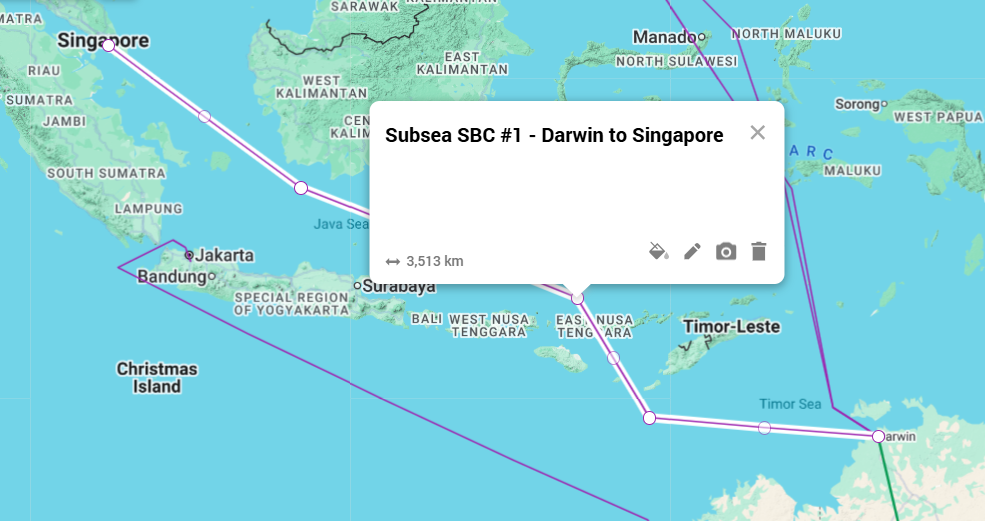
The Sun Cable / Australia-Asia Power Link route. Already approved by both the Australian Commonwealth (August 2024) and the Singapore Energy Market Authority (October 2024). Sun Cable's scope is a 4,300 km cable carrying 1.75 GW of electricity to supply up to 15% of Singapore's total demand. The MMA corridor on this route is the extension of that precedent into a sovereign Australian programme with electricity capacity scalable beyond the Sun Cable design, plus fibre as a default service, plus capacity for gas, hydrogen, or water if Singapore's industrial roadmap calls for them. Singapore is the gateway market for the entire Strait of Malacca economy.
2.2 Route 2 — Derby to Jakarta
Derby → Jakarta
~3,000 km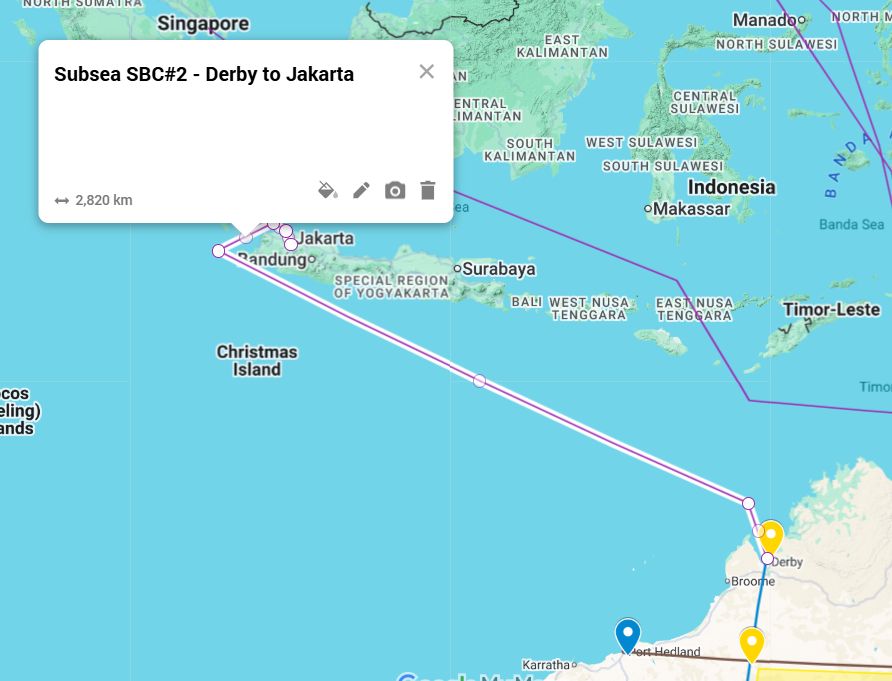
Derby is the natural landing-station location on the Western Australian coast facing Indonesia. Jakarta is the demand centre of the Indonesian archipelago — the largest single electricity market in ASEAN by population, with ~280 million people and rapid load growth driven by industrialisation. Indonesia is also the geographic centre of the ASEAN Power Grid framework. A direct Australia–Java cable connects the Australian generator pool into the heart of the ASEAN grid by the shortest geographic route.
2.3 Route 3 — Newcastle to New Zealand
Newcastle → New Zealand
~3,000 km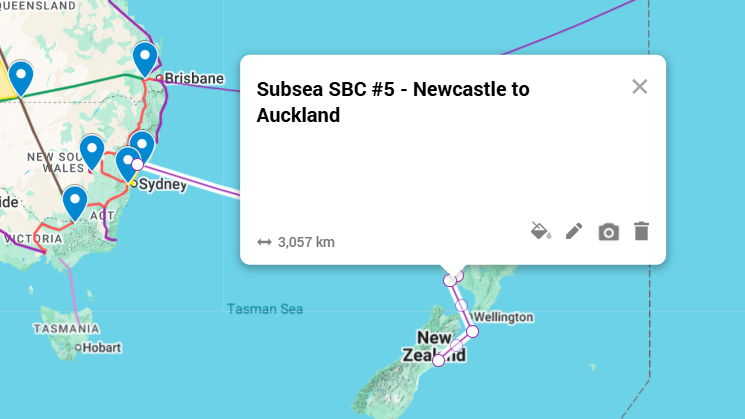
The trans-Tasman connection. Independently proposed in March 2025 by the Taslink venture as a 2,600 km, 2–3 GW HVDC cable from south of Auckland to Newcastle NSW. The MMA version of this route is the same destination, with the multi-service corridor architecture. The bidirectional value proposition is exceptional: New Zealand's morning peak is followed by Australia's morning peak; New Zealand's evening peak is followed by Australia's evening peak; trading flows continuously in both directions throughout the day. The route also enables shared backup capacity — New Zealand's hydro reservoirs become a strategic energy store for the eastern Australian grid, and Australia's solar firms the New Zealand grid through cloudy periods.
2.4 Route 4 — Vietnam to Darwin
Vietnam → Darwin
~4,000 km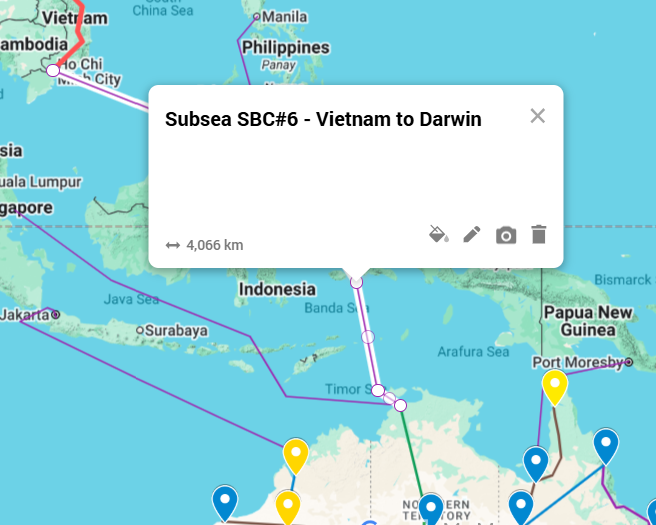
Vietnam is the fastest-growing electricity market in ASEAN with ~100 million people and an industrial economy that doubles its grid demand every 8–10 years. The current Vietnamese generation mix is dominated by coal and is structurally short of zero-carbon supply. A direct Australia–Vietnam corridor delivers utility-scale clean electricity into Hanoi or Ho Chi Minh City load centres without forcing Vietnam to find tens of gigawatts of domestic land for solar and wind. Vietnam is also a manufacturing partner candidate for the eventual extension of the network onwards to Japan and Korea.
2.5 Route 5 — PNG to Karumba
Papua New Guinea → Karumba
~1,500 km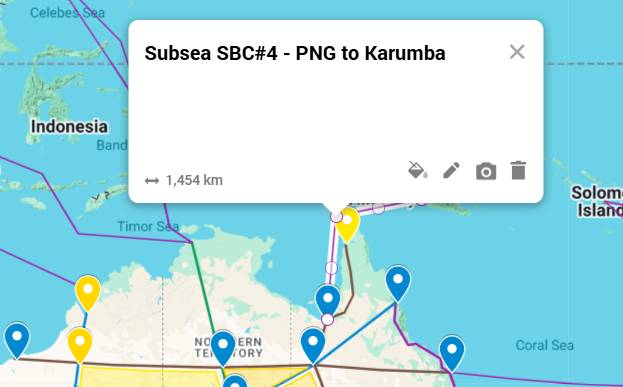
The shortest route in the network and the only one carrying gas as a confirmed first-deployment service. Papua New Guinea holds significant gas reserves in the Hela and Gulf provinces, currently routed exclusively to LNG export through the PNG LNG facility at Caution Bay. A direct pipeline connection from PNG to the Karumba landing point on the Gulf of Carpentaria integrates PNG gas into the Australian east-coast gas market, which structurally needs more upstream supply (see Gas pillar on this site). PNG also gets a stable, neighbouring industrial market for its gas at a time when global LNG demand is politically and economically volatile. The corridor additionally carries an electricity link — PNG's grid is small and currently runs on diesel generators in the highlands; a 1,500 km HVDC tie to the Australian grid stabilises PNG's electricity supply at marginal cost. Fibre is carried on the same corridor structure as the gas pipeline and electricity cable.
2.6 Route 6 — Darwin to Manila
Darwin → Manila
~3,500 km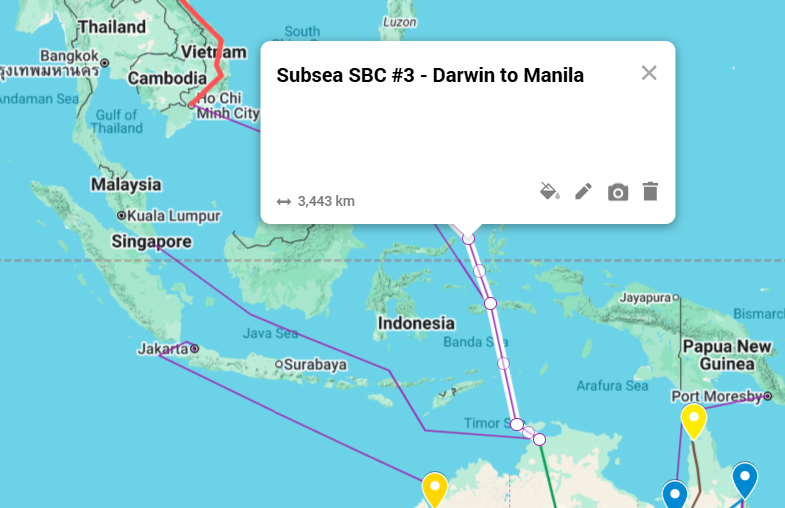
The Philippines is ~115 million people and an archipelagic grid running on a high proportion of imported coal and oil. The Philippines also has the longest-standing academic proposal for an Asia-Pacific super-grid — the Japan Policy Council 2011 proposal extended in 2020 ScienceDirect analysis identified the Philippines as a natural hinge node between Australia, Japan, Taiwan, and Indonesia. The Darwin–Manila corridor delivers Australian renewable electricity into the Manila load centre directly, and positions Manila as the future node for onward connection to Taiwan, the East Asian mainland, and Japan as the network extends.
2.7 Route 7 — The Pacific Loop
The Pacific Loop
~14,000 km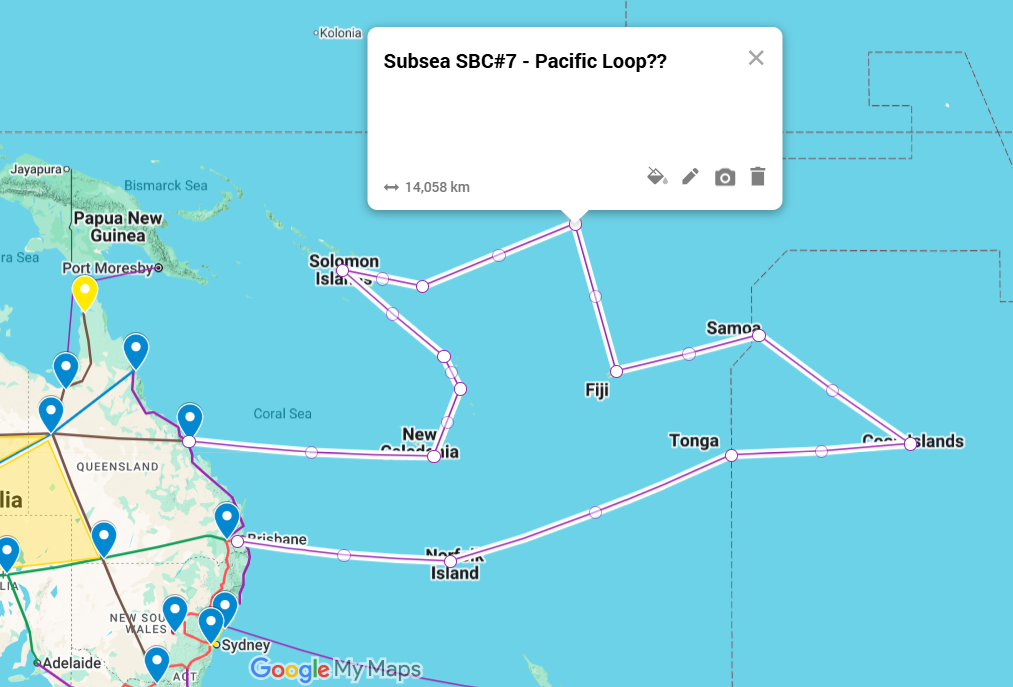
A ~14,000 km subsea corridor running from northeast Australia through the Pacific island chain — Solomon Islands, Vanuatu, Fiji, Tonga, Samoa, the Cook Islands — and back to Australia. The loop architecture is qualitatively different from the other six routes: it is not a point-to-point cable, it is a closed ring with each participating nation connected via a short spur. Loop design, the case for Pacific island nation interconnection, and regional strategic positioning are the subject of Memo 29; for the purposes of this memo it is one of the seven corridors that anchors the Australian industrial base.
2.8 The service matrix
The full service stack across the network:
| Route | Distance | Electricity | Fibre | Gas | Hydrogen | Water |
|---|---|---|---|---|---|---|
| Darwin → Singapore | 3,500 km | ✓ | ✓ | possible | possible | possible |
| Derby → Jakarta | 3,000 km | ✓ | ✓ | possible | possible | possible |
| Newcastle → NZ | 3,000 km | ✓ | ✓ | possible | possible | possible |
| Vietnam → Darwin | 4,000 km | ✓ | ✓ | possible | possible | possible |
| PNG → Karumba | 1,500 km | ✓ | ✓ | ✓ | possible | possible |
| Darwin → Manila | 3,500 km | ✓ | ✓ | possible | possible | possible |
| Pacific Loop | 14,000 km | ✓ | ✓ | possible | possible | possible |
| Network total | ~32,500 km | 7 corridors with electricity + fibre confirmed; gas confirmed on PNG–Karumba; remaining services activated as destination-nation demand is established. | ||||
3. The engineering envelope
Every distance and depth required by the seven-leg network sits inside the envelope of technology already operating commercially or in advanced construction by 2026. Sun Cable is approved by both the Australian and Singaporean governments for a 4,300 km HVDC subsea link. Xlinks is constructing 3,800 km Morocco to the UK. Viking Link is operating at 765 km. Industry depth records have re-set to 3,000 metres. The industry has converged on ±525 kV mass-impregnated HVDC as the standard for long-distance subsea installations.
The MMA programme is not asking the world to invent new physics. It is commissioning the integration engineering — how multiple services are supplied on separate spools and joined into a single corridor by the cable-lay vessel during installation, at continental scale — and the manufacturing and install capacity to deliver it. Engineering details settle inside the Consortium working groups in partnership with the named industry leaders.
4. Programme benefits
The seven-route network is the structural backbone. The benefits it returns cover grid stability, regional interconnection, climate, pricing, defence-industrial capability, and continuous Australian industrial activity. This section addresses each in turn.
4.1 Grid stabilisation across the region
Bidirectional flow on every corridor smooths peak and off-peak demand across the participating grids. Peak demand in the destination grids generally coincides with off-peak periods in the Australian grid; Australian renewable surplus flows to destination-nation demand peaks, and destination-nation storage, hydro, gas peakers, and demand-side flexibility flow back during Australian renewable troughs. The trans-Tasman corridor (Route 3) is the clearest case: New Zealand hydro storage firms the eastern Australian grid; Australian solar firms New Zealand through cloudy periods.
The same dynamic that makes the European interconnection grid (ENTSO-E) work operates here. A grid that imports and exports continuously is more stable than a grid operating on its own generation alone. Frequency stability improves. Reserve requirements fall. Renewable penetration becomes commercially viable at higher proportions because surplus in one grid sells into deficit in another rather than being curtailed.
4.2 The Asia-Pacific equivalent of ENTSO-E
The European continental grid demonstrates how regional electrical interconnection works at scale. 39 countries, 500+ GW of installed generation, hundreds of cross-border interconnections, frequency synchronisation, cross-border power trading worth tens of billions of euros annually, running commercially since the 1950s.
The Asia-Pacific equivalent does not yet exist. The MMA subsea network is the proposition to build it. The starter network connects Australia to ~600 million people across seven economies. As the network grows, the destination nations' own onward grid connections (Singapore-Malaysia-Thailand, Indonesian inner archipelago, Vietnam-Laos-Cambodia, Philippines-Taiwan-Japan) pool into a coordinated regional grid serving 2–3 billion people by 2050. Australia is the largest generator and the central node.
The political framework is largely in place. The ASEAN Power Grid Enhanced MoU was signed at the 43rd ASEAN Ministers on Energy Meeting in October 2025, alongside the formal endorsement of the ASEAN Subsea Power Cable Development Framework. Three of the seven MMA routes land at ASEAN signatory states. The Japan-Taiwan-Philippines academic proposal (Japan Policy Council 2011, extended by Itiki et al. 2020 ScienceDirect) explicitly identified Australia as the bulk renewable supplier in the regional grid topology. The MMA network is the deployment of work the region's policymakers and engineering literature have been building toward for over a decade.
4.3 Net zero contribution at regional scale
Coal generation in Vietnam, the Philippines, Indonesia, and Singapore contributes to global atmospheric emissions on the same basis as coal generation in Australia. Australia displacing its own coal accelerates Australian net zero (covered in Memo 25); Australian electricity displacing destination-nation coal accelerates regional net zero. The displaced emissions in the destination nations exceed Australia's total domestic emissions footprint, so the regional displacement contribution is larger than the domestic displacement contribution.
The MMA subsea network is the physical infrastructure that delivers regional decarbonisation at scale. Each gigawatt of Australian renewable electricity delivered into Singapore, Manila, Jakarta, Hanoi, or the Pacific island grids displaces a gigawatt of imported coal or domestic diesel generation. The starter network can deliver tens of gigawatts; additional install lifts per route multiply the figure.
The Paris Agreement Article 6 framework (finalised at COP29 in 2024) allows the exporting nation to retain a verified share of the emissions reduction generated by displaced foreign coal. The mechanism is developed in Memo 25; for this memo the relevance is that the network monetises the regional decarbonisation contribution through an established international framework.
4.4 Continuously declining unit cost over the programme's life
The first install of any route includes the corridor survey, the political and regulatory approvals, the landing-station civil engineering, and the consortium engineering for that specific route — all sunk cost from the first deployment. Subsequent installs along the same approved corridor reuse those inputs without redoing them. The vessel fleet returns to the same survey-cleared route, deploys cable and service-line sections along the established path, joins them using the established install method, and lands them at landing stations already built.
The same dynamic operates across routes: the first route's install commissions the vessel fleet, the joining technology, the cable manufacturing line, the repair fleet, and the consortium engineering organisation. The second route inherits all of it. By the seventh route, every cost input that can be productised has been productised. Comparable productisation curves in adjacent industries indicate the scale of the cost decline available: utility-scale solar PV fell ~90% in unit cost over 2010–2020 through industry productisation; onshore wind fell ~70% over the same period. The exact subsea HVDC curve is the subject of Memo 28.
The destination nations see this in the delivered price. Year-one electricity into Singapore is at the cost of a first-of-kind continental subsea programme. Year-ten electricity is at the cost of a productised, repeat-install regional infrastructure programme. The improving unit economics make additional routes more competitive against destination-nation domestic alternatives at each subsequent decision point.
4.5 The AUKUS industrial base, extended
The AUKUS programme is the largest single investment in sovereign Australian maritime industrial capability in the country's history: dockyards, shipyards, heavy fabrication, marine workforce training, the steel supply chain, and the bilateral industrial relationships with the United Kingdom and the United States. The MMP position on AUKUS is set out in Memo 18 — Defence Through Nation Building: the programme is repositioned away from a small fleet of nuclear submarines toward unmanned coastal defence platforms, sovereign defence manufacturing, dual-use civilian vessels, and the maintenance, inspection, and repair capability that ongoing Australian submarine operations require. None of the AUKUS investment is wasted. The industrial base, the workforce, and the bilateral relationships all stay; what changes is the output mix.
The subsea corridor delivery industry is one of the civilian dual-use outputs Memo 18 names. The cable-lay vessels, pipe-laying vessels, survey ships, trenchers, and the regional repair fleet are built in the same shipyards by the same workforce that AUKUS commissions. The capability map overlaps:
- Heavy maritime engineering at sovereign Australian shipyards
- Large-vessel construction capacity
- High-pressure underwater systems and joining technology
- Marine welding and pipe-laying at scale
- Sovereign sonar, survey, and seabed-mapping capability
- Lifetime repair and maintenance logistics for assets at depth
- The technical labour pool that runs all of the above
The subsea corridor adds continuous civilian commercial load to the same industrial base. The shipyards stay productive between submarine and unmanned-platform build cycles. The workforce stays employed across multi-decade horizons. The supplier relationships keep operating. The same dockside crane that fits a submarine pressure-hull section fits a cable-laying carousel; the same welders that join naval steel join pipeline steel; the same survey vessels that map a defence operating area map a subsea corridor route. The dual-use nature of the capability is the point: a sovereign Australian cable-lay, pipe-lay, and repair fleet is itself a strategic maritime asset, available for defence use when required and generating commercial revenue when not.
What the subsea corridor adds to the AUKUS industrial base is detailed in Memo 27 — The Subsea Industrial Base, and on the Manufacturing pillar. The relevant point for this memo: the corridor programme does not require Australia to build a new sovereign maritime industrial base. It uses the one AUKUS is already building.
4.6 Strategic interconnection — the long-horizon picture
The seven-route network is the starter set. As destination nations expand their own grid connections, the eventual outcome is a full Asia-Pacific interconnected grid — the ENTSO-E equivalent for the region. Natural extensions from the starter network include Manila–Taiwan (~600 km, completing the Japan Policy Council 2011 topology), Taiwan–Japan via the Ryukyu chain, Korea via Japan, India via Singapore, and the broader Pacific island chain via extensions from the Pacific Loop. Each extension uses the same consortium, the same Australian manufacturing base, the same Australian-led install fleet, the same engineering standard.
By 2050 the network completed from the starter set serves the largest single regional electricity grid on Earth by population. Australia is the central node, the largest generator pool, the regional installer of record, and the standard-setting consortium leader.
5. Sovereign Australian manufacturing and install
5.1 What the network demands
Approximate scale of the demand created by the seven-leg starter network:
Cable and service-line manufacturing
Every route requires HVDC cable, fibre, and the optional gas, hydrogen, or water service lines — each manufactured on standard subsea industry production lines and supplied on spools for vessel install. The network requires more subsea cable and service-line production than the world's existing facilities can supply in any reasonable timeframe. A dedicated Australian manufacturing complex, sized to deliver the seven-leg network, has decades of work in hand from this programme alone — before any additional routes, additional install lifts per route, or export sales to other regions are considered.
Cable-laying ship fleet
Dedicated cable-lay vessels with deep-water capability and continental-distance endurance. The global fleet of HVDC-capable cable-lay vessels is currently fewer than two dozen ships. The MMA network alone requires multi-year deployment by a dedicated regional fleet of these vessels — Australia builds and operates the fleet rather than chartering it from European or Japanese contractors.
Trenchers and burial ROVs
Cable-burial trenchers and remotely-operated vehicles for protecting the cable from anchor strike, fishing gear, and current scour. Currently dominated by European specialist operators (DEME, Boskalis, Allseas). Australia builds and operates its own fleet for the regional market.
Converter stations and transformers
HVDC converter stations at each landing point — including the Australian-side stations at Darwin, Derby, Newcastle, and Karumba. Transformers, valve halls, cooling systems, and control infrastructure. Manufactured in Australia under license and joint venture with Hitachi Energy, Siemens Energy, GE Vernova, or Mitsubishi Electric.
Subsea connectors and joints
Wet-mateable connectors, repair joints, and branching units for the cable network. Currently a small specialised market dominated by SLB, Siemens Subsea, and JDR Cable Systems. The branching topology of the Pacific Loop and the multi-segment architecture of the network creates a much larger market than current global demand — Australian sovereign capability in this technology is feasible.
Survey vessels and marine services
Survey ships, ROV operators, marine geophysical contractors, environmental survey teams. Currently dominated by Fugro and DOF Subsea. The continuous survey workload for the seven-leg network — pre-install routing, install support, periodic inspection, repair survey — sustains a sovereign Australian marine services industry for decades.
Pipeline laying capability
For the PNG–Karumba gas pipeline and any subsequent gas, hydrogen, or water services on other routes. Pipeline-lay vessels (S-lay, J-lay, reel-lay), welding and inspection equipment, pipeline trenchers. Currently dominated by Saipem, McDermott, Allseas, and Subsea7. Australia builds the capability in partnership with these firms.
Repair fleet (lifetime service)
Dedicated repair vessels stationed regionally for the lifetime of the network. Subsea cable repair currently costs hundreds of thousands of dollars per incident, takes weeks per repair, and is dominated by a small number of specialised contractors. The MMA network creates enough sustained repair workload to support an Australian repair fleet permanently — protecting the entire network and offering repair services regionally as well.
5.2 The Apollo-Soyuz architecture — cooperation in technology, sovereignty in install
The MMA subsea network is built using the same architectural principle as the MMA land corridor and the MMA Consortium proposition (see Memo 24). Australia does not invent or replace the established global technology of subsea cable, subsea connectors, converter stations, transformers, and offshore install equipment. Australia uses the established global technology, in partnership with the named experts of each field, and builds sovereign Australian capability in install, integration, operation, and lifetime service of the network.
The cables are manufactured in Australia under joint venture or license with Prysmian, Nexans, NKT, Sumitomo Electric, or similar — same companies named on the MMA Consortium page for the HVDC cables working group. The converter stations are manufactured in Australia under joint venture or license with Hitachi Energy, Siemens Energy, GE Vernova, or Mitsubishi Electric — same companies named for the HVDC converter stations working group. The ships are built in Australian shipyards in partnership with Hyundai Heavy Industries, Mitsubishi Heavy Industries, Vard, or Damen.
The install, the integration, the survey, the trenching, the connection, the repair — all sovereign Australian. The technology comes from the established global experts who already make it. Australia becomes the largest single deployer of subsea infrastructure in the Asia-Pacific by virtue of running the largest single subsea network in the region. The install capability is continuously exportable as a service to other nations that want to build their own subsea infrastructure.
The shipyard, steel, and marine engineering overlap with the AUKUS programme is developed in Section 4.5.
5.3 Why Australia is positioned to lead the install
Four reasons Australia is the natural location for the regional subsea infrastructure delivery industry:
- Geography. Australia is the centre of the seven-leg network. Every route originates from an Australian landing point. Survey, install, and repair operations are launched from Australian ports — Darwin, Derby, Newcastle, Karumba, plus Townsville and Brisbane for the Pacific Loop.
- Industrial base potential. Australia has the steel industry (with the planned MMA manufacturing programme), the heavy-engineering shipyards, the offshore oil and gas heritage (Bass Strait, North West Shelf), and the technical labour force to deliver the work. What is missing is the consortium and the manufacturing programme to consolidate these into a coherent industry — which is what the MMA programme delivers.
- Sovereign electricity supply. The reason this network exists is that Australia produces — or will produce — the cheapest sovereign electricity in the developed world (see Memo 13 — The Power Imperative). The same renewable surplus that fills the cables also runs the manufacturing plants, the ports, and the install fleet that delivers them.
- Diplomatic position. Australia has working trade, defence, and infrastructure relationships with every destination nation in the seven-leg network. No other potential supplier of regional subsea infrastructure has comparable diplomatic standing across the entire region.
6. Continuous deployment
The starter network is the first deployment. The programme has no completion date because the network continues to grow, the unit cost continues to fall, and the standard continues to export. Three independent expansion vectors operate at different timescales.
6.1 One line, then two
Each route is deployed first as a single install — one HVDC capacity baseline, fibre, and whatever optional services the destination nation requires from day one. As demand grows, the same approved corridor takes a second install lift, then a third. The corridor survey, the political and regulatory approvals, the landing-station civil engineering, and the consortium engineering are all sunk-cost from the first deployment; each subsequent install reuses them. A route that opens at 2–3 GW of HVDC capacity scales to 10 GW or more over the decades the network operates, without renegotiating a single approval or surveying a single new corridor.
6.2 New routes to new nations
The seven-route starter set is bounded by Australia's closest and most directly-served regional partners. As the programme matures, additional routes connect additional nations. Manila–Taiwan extends the network east. Taiwan–Japan via the Ryukyu chain reaches the Japanese market. Korea connects via Japan. India connects via Singapore. The Pacific Loop extends to Hawaii, French Polynesia, the Marshall Islands, and onwards. Each new route uses the same consortium, the same Australian manufacturing base, the same Australian-led install fleet, and the same engineering standard established during the starter deployment. The programme expands geographically for as long as there is demand to expand it.
6.3 The standard exported to other regions
The MMA multi-service corridor install method is exportable intellectual property. Other regions that want to build subsea infrastructure — the Mediterranean basin, the North Sea, the Caribbean, the East Africa coast, the Arabian Gulf — can adopt the MMA standard, procure their deployment from the Australian-led delivery industry, or build their own delivery capability under the same standard with Australian engineering partnership. The Asia-Pacific deployment is the proving ground; the standard rollout to other regions is what keeps the Australian manufacturing and install industry busy long after the Asia-Pacific network reaches steady state.
6.4 Continuous industrial commitment
The combination of these three vectors — more capacity on existing routes, more routes to more nations, the standard exported to more regions — produces continuous work for the Australian manufacturing and install industry across multi-decade horizons. The structure differs from a defence procurement programme with a completion date, a single-customer commercial contract with a delivery schedule, or a one-shot infrastructure build with a closing ribbon: there is no defined endpoint because the demand the programme serves is structural, regional, and growing.
The continuous deployment structure delivers: continuous employment for the technical labour pool, continuous capital investment in manufacturing capacity, continuous engineering work for the consortium organisation, continuous revenue from delivered electricity, fibre, and integrated services, and continuous standard-licensing income from other regions adopting the MMA method.
7. Summary
Seven subsea multi-service corridors from Australia, approximately 32,500 km combined. The technology is operationally proven. The political framework is established via the ASEAN Power Grid Enhanced MoU (October 2025) and the ASEAN Subsea Power Cable Development Framework endorsed at the same meeting. The Sun Cable Australia–Singapore link is approved by both source and destination governments. The Asia-Pacific super-grid topology has been studied in the engineering literature since the Japan Policy Council 2011 proposal and the Itiki et al. 2020 ScienceDirect extension.
Programme benefits are summarised in the executive summary table at the top of this memo and developed in Section 4. The Australian industrial base is detailed in Section 5. The continuous-deployment structure is detailed in Section 6.
Engineering details — final voltage class, cable cross-section, joining and install method, repeater architecture, service-line tolerances, landing-station configuration, repair-joint design — settle inside the Consortium working groups in partnership with the named industry leaders. One corridor, one install, multiple services is the architectural commitment.
What Australia builds to deliver this network — the cable factory, the vessel fleet, the transformer assembly, the subsea connectors, the install services, the repair fleet — is the subject of Memo 27. The economic case — revenue, markets, payback — is the subject of Memo 28. The Pacific Loop design, the case for Pacific island nation interconnection, and the strategic positioning argument are the subject of Memo 29.