The Prize: A Unified AsiaPac — Extended
Because the war cannot be won, peace is the rational move — and the prize is the prosperous, neutral, united Asia-Pacific that choice unlocks.
Added two figures to §1 (Mutually assured dependence): the Asia-Pacific trade-interdependence chord diagram and the bulk-shipping dependence chart. New captions are marked in blue.
Globalisation has woven the nations of the Asia-Pacific so tightly together — each now depending on the others for the energy, food, goods and customers it cannot live without — that war between them has become a game no one can win. A conflict that cuts those ties ruins every side at once; the defence series proves it case by case. And once a war cannot be won, the logic of force collapses: arming harder buys nothing a blockade cannot take away, and the only security that holds is the kind that cannot be strangled — self-reliance. What remains is a single rational move, the same one for every player at the table: keep the peace — the equilibrium of a game whose outcome is already solved. Everything that follows — the prosperity, the harmony, the prize — is what that peace makes possible, once the region accepts the maths and chooses to negotiate its future rather than fight over it: to build, in place of a board of rivals, a union of neighbours working together for the good of their people.
The argument in brief
- The premise is game theory, not sentiment: because globalisation has made the region's nations mutually dependent, war between them is negative-sum — everyone loses — and in a game like that the only rational move left is peace. The defence series proved the war cannot be won; this memo draws the conclusion.
- Take war off the board as a move that can ever pay, and every dispute that remains must be settled at a table rather than a trench, because none of them can be settled by force. That is the prize: a region that negotiates its problems instead of fighting over them.
- The shape of that prize is a union — not a superstate, but sovereign nations working together, the way Europe's old enemies bound their economies after 1945 and have not fought since. Individual nations, each keeping its own government and identity, cooperating for the good of their people.
- The things the region needs to prosper — energy, education, connection, and people who can live together — are things Australia holds in surplus. A continent that powers, teaches and welcomes its neighbours is not an outpost on the edge of Asia. It is part of it.
- The hardest cases — Korea, Taiwan — are frozen by bloc logic, not nature, and the same game theory bears hardest here: war there is mutual ruin, and any of these conflicts can escalate into a great-power war — millions dead, under a nuclear shadow — which is why no one can gamble on it staying contained. A negotiated settlement is the only rational end, and a neutral Australia could be one of the brokers who helps the parties reach it — the peacemaker's role, which only neutrality unlocks.
- Peace pays a dividend no weapon can. The world spends nearly US$2.9 trillion a year on its militaries; prove that interdependence beats deterrence and that spending is freed — for building, healing, teaching, and reaching. Australia's share of it is the $368 billion: submarines, or the nation.
- One discipline holds it up: the prize stands alongside self-reliance and a real military, never instead of them. A nation still needs the lock on the door; it simply cannot eat the lock when the lanes close. Trade is the carrot; being unstranglable is the insurance.
---
1. Mutually assured dependence
The premise is a piece of game theory; the whole vision stands on it.
Start with the trap the region is in now. Each nation arms for its own safety; every neighbour reads that arming as a threat and arms in turn; all of them end up less secure than when they began, having spent a fortune to get there. This is the security dilemma, and it is the machine driving the world's nearly US$2.9 trillion a year in military spending. Force alone cannot get a nation out of it, because every weapon bought to feel safer makes someone else feel less safe, and the spiral turns again.
Now add what globalisation has done to the structure of the game. A war fought once, in isolation, can reward the aggressor — strike first, win, take the spoils. But the nations of the Asia-Pacific do not deal with one another once; they trade every day and depend on each other permanently. When a game repeats without end and the players need each other's future cooperation, the maths shifts: cooperation becomes the rational strategy even for purely self-interested players, because the lasting value of the relationship outweighs anything a single betrayal could seize. This is the established result of the mathematics of repeated games, and globalisation is what makes the game repeat forever — it lengthens the shadow the future casts over the present until war stops paying.
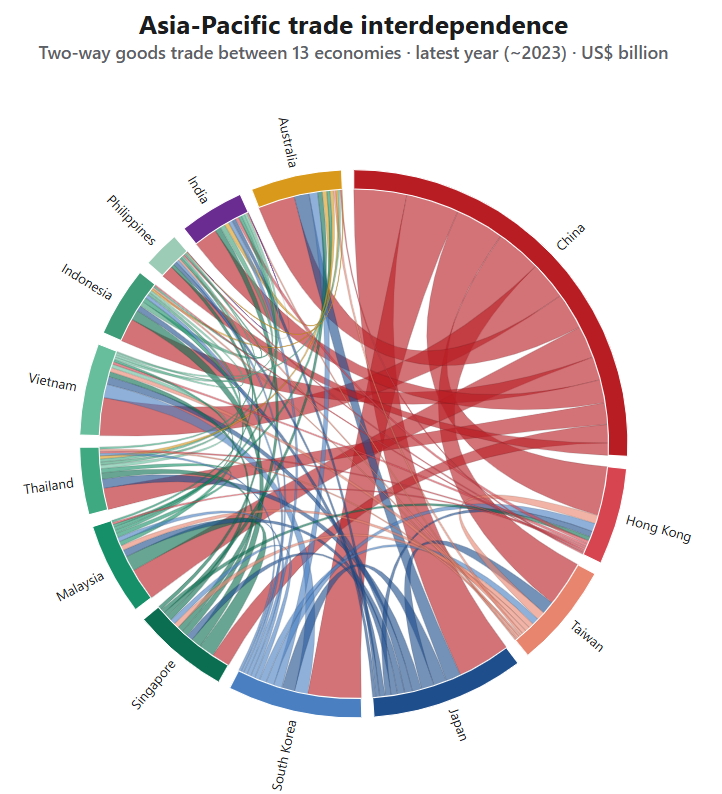
Put the two together and the conclusion is not a hope but a solved equation. The game now repeats endlessly, and the win-by-force move has been removed, because the war is negative-sum — everyone loses. In a game like that there is one rational play: cooperate. No clever first strike, no victory for the side that arms hardest. It is the old logic of mutually assured destruction turned by a single degree. The Cold War kept its peace through the certainty of annihilation; the Asia-Pacific can keep its peace through the certainty of ruin — mutually assured dependence — and the difference is everything, because the cure is not a balance of terror but a turn toward self-reliance.
This is not a theory waiting to be tested. It has already been run, on the continent that invented modern war. For centuries the nations of Europe fought one another without pause; France and Germany alone fought three ruinous wars in seventy years. After 1945 they tried the opposite move — binding their economies together on purpose, first their coal and steel and then their whole markets, so that war between them would become not merely unthinkable but materially impossible. It worked. States that had bled each other white for a thousand years have not fought since. The European Union is many things, and not all of them admired, but at its foundation it is the proof that the maths in this memo is real: tie nations together tightly enough and the rational move becomes peace — and stays peace.
That turn breaks the trap, through an asymmetry. Most military spending is double-edged: the missile that shields me could also strike you, so you arm in response and the dilemma turns again. Self-reliance is the one form of security that threatens no one. My fuel reserves, my food, my domestic industry, my ability to keep my own lights on through a blockade — none of it menaces a neighbour or gives anyone cause to arm against me. It raises my security without lowering anyone else's. So every nation in the region can reach for real safety at once, and instead of a spiral of mutual threat the result is a region of nations each harder to coerce and none more dangerous to the others. The thing that protects you also adds to the harmony around you.
None of this means a nation disarms. A military is still necessary — to deter the opportunist, defend the continent, raise the cost of an attack past what anyone will pay. What the defence series shows is only that force cannot save you in the contest that actually decides a trading nation's fate: it cannot feed you, fuel you, or keep you supplied when the lanes close. The military is the lock on the door; self-reliance is the food in the pantry. A nation needs both, and the error AUKUS makes is to spend everything on a bigger lock while the pantry stays empty.
One piece remains, and it explains why the region has not already settled into this peace on its own. The local players, left to their own repeated game, would converge on cooperation — the maths pushes them there. But there is an outside player at the table whose payoff runs the other way. A distant power whose advantage lies in being the region's indispensable protector has a standing interest in the region staying divided, because a region that cannot secure itself needs a patron, and a patron's leverage depends on the threat never quite going away. This is not an accusation of malice; it is a reading of incentives, the kind any clear-eyed strategist will recognise. As long as the region builds its security around that outside guarantor, it keeps an interest in division seated at its own table, and the game cannot resolve. The way out is not to expel anyone — it is to stop letting the outsider's incentive set the region's equilibrium. Once the nations of the Asia-Pacific solve their own game among themselves, too entangled to fight and too resilient to be coerced, the outside interest in their division has nothing left to grip, and the demand for a distant umbrella falls away on its own — not because anyone is pushed out, but because a region that cannot be picked apart no longer needs one. That is the prudent path in any case, with a guarantor that has spent recent years telling its allies, in word and deed, to look to themselves.
And there is an invitation in this, not an expulsion. The outside power faces the same arithmetic as everyone else: it cannot win this war either, and a strategy of holding a region together by keeping it divided buys less security with every year the missiles get cheaper. The region's answer is not to shut the door on it but to hold one open — to a distant power willing to join a peaceful, prosperous Asia-Pacific as a partner in its trade rather than the manager of its divisions. That is a choice only Washington can make, and the door stays open either way. What the region stops doing is arranging its own security around an outsider's stake in its disunity.
2. Logistics, not firepower — and who loses first
There is a second reason the war cannot be won, and it is the one almost no one is looking at, because the strategic debate is mesmerised by firepower: submarine counts, missile counts, who can sink whom. Firepower matters — but between interdependent economies it does not decide the outcome. Logistics does: who stays supplied, who keeps the fuel and food and components moving, who can endure when the lanes close. And on that ground the board is not even.
China spent twenty years making sure of it. After it named its "Malacca Dilemma" in 2003 — the fear that its seaborne lifelines could be severed at a chokepoint — it built its way out: overland oil and gas pipelines from Russia and Central Asia, the rail-and-pipeline corridor through Myanmar that bypasses the Malacca Strait, strategic reserves, domestic production, and demand it can shed. It built continental depth, supply drawn across fourteen land borders that no navy can blockade. The maritime nations of the region — Japan, Taiwan, the Philippines, Australia — did the opposite. They stayed wholly dependent on seaborne supply through a handful of chokepoints, and answered the threat by buying expensive platforms to fight over those chokepoints. Two decades on, one side has prepared the logistics ground and the others have not.
The firepower picture compounds the problem rather than fixing it, because the missile age has inverted the maths of attack and defence. Cheap, plentiful missiles and drones now beat scarce, costly platforms and interceptors. A forward base is a fixed target a salvo can crater. A surface ship inside missile range can be found and ranged, and must stand off at a distance that blunts its use. Every incoming cheap drone is met, if at all, by an interceptor costing millions, fired from a magazine that empties long before the attacker's does. The advantage in that exchange sits with whoever has built the larger, cheaper arsenal and the depth to keep firing — which, in its own near seas, is China.
Iran has just proved the mechanism, against the United States, cleanly. In the 2026 war over Hormuz a second-tier power with missiles and drones kept the world's most important oil chokepoint all but shut, and the strongest navy on earth could not reopen it by force. Holding that lane, the United States burned through its munitions at a rate no one can sustain: by the Center for Strategic and International Studies' analysis, American forces expended roughly half their Patriot interceptors and more than half their THAAD stock in weeks — several years of production consumed in a thirty-nine-day campaign, against Iran, not a peer. Iran sent cheap drones first to draw down the expensive interceptors before the missiles arrived: death by a thousand cuts, the weaker side's rational play. CSIS's own conclusion: every interceptor fired at Iran is one unavailable in the Pacific, and the war opened "a window of increased vulnerability in the western Pacific" that will take years to close. If a middle power can impose that cost and hold that lane, the peer power that spent twenty years building the same tools at scale can do it by an order of magnitude more.
Put the two together and the picture is stark — but it is not "China wins." It is that on the contest which actually decides the war, the unprepared lose first and worst, and no submarine refills a tanker or reopens a strait. China would not win such a war either; it would endure it longest, the last one standing in a burned-down house, its markets gone and its prosperity wrecked. There is no victor, only an order of ruin — and the maritime nations are at the front of the queue. That is exactly why this is the argument for self-reliance, not against it. The asymmetry that exists today — one side prepared, the rest exposed — is the unstable, dangerous condition that tempts a war in the first place. A nation that makes itself unstranglable takes itself off the front of the queue; and when every nation in the region is unstranglable, the logistics war has no winner left to tempt anyone, and the peace sits on firm ground. Self-reliance is what closes the gap and steadies the board.
A blockade's first victims are civilians, and they suffer fast. Australia exports most of the food it grows — but the system that harvests, moves and refrigerates that food runs almost entirely on imported diesel, and the country holds only weeks of it. Cut the tankers and a food-exporting nation's cities go hungry within weeks — not because the food is not there, but because there is no fuel to reap it, no fuel to truck it, no power to keep it cold — and the fertiliser and the additives next season's crop depends on are shipped in too. That is what "undefendable" means in human terms: not a beach lost to an invader, but a population that cannot be fed because a handful of tankers were turned back. It is the sharpest reason of all that self-reliance is not an economic preference but the line between a nation that endures a siege and one that breaks under it.
The missile-counters' imagined war is clean and contained — a duel of long-range fire between Washington and Beijing, settled on platform counts. There is no contained version. A great-power exchange is fought across the Asia-Pacific: its seas, its skies, the bases on its soil, the cities beside those bases, the trade lanes that are its lifeblood. The two principals have continental depth and an ocean between them and the worst of it; the nations of the region have neither. They are the theatre. They take the strikes, host the bases that draw the strikes, lose the trade that feeds them — and carry the tail risk every great-power war has carried since 1945: allies pulled in, escalation no one can switch off, the slide toward a third world war and the nuclear shadow over all of it. For the region this is not a war to win or even to endure. Preventing it is the whole point — the overriding aim every other policy in this series answers to. And the way a nation prevents it is to become unstranglable, to stay neutral, and to build the peace — never to capitulate, which only invites the next demand. A region too resilient to be picked off and too entangled to be worth fighting is how the war is kept from starting.
3. The table, not the trench
Here is what the solved game makes possible — the heart of the prize. Take war off the board as a move that can ever pay, and every dispute that remains must be settled at a table — because none of them can be settled by force.
Peace is not merely the absence of war; it is the presence of a standing table at which any issue — a contested border, a fishing ground, a sea lane, a mineral field, the status of an island — has to be negotiated, because the alternative has become ruin for all and everyone in the room knows it. Coercion stops working when the threat behind it is suicidal. Negotiation becomes the region's default way of doing business, not because its nations have grown saintly, but because the maths leaves them nothing else. The same disputes that today are managed by warships and grey-zone pressure become, in a region that has accepted the game, matters for diplomats and treaties and trade — slower, less dramatic, and incomparably cheaper in blood and treasure.
And there is a name for where this leads, near enough: a union. Not a superstate, not one capital ruling the rest, and not a copy of Europe's institutions — the Asia-Pacific is far more varied than post-war Europe was, in wealth, in history, in how its nations govern themselves and in the disputes still live between them, so any coming-together here would have to be looser, slower, and built on sovereignty rather than over it. But the founding principle is the same one that ended Europe's wars: individual nations, each keeping its own identity and its own government, choosing to work together — on trade, energy, standards and the shared problems no nation solves alone — because together they are safer and richer than apart. A union of sovereign neighbours working for the good of their people rather than against one another. That is the truer shape of the prize: not Australia supplying a region from the edge of it, but Australia as one nation among many in a region that has chosen cooperation over conquest.
And the moment a region settles its quarrels at the table, the things that build prosperity are free to flow. The Indo-Pacific is already the engine of the world economy — around 60 per cent of global output and two-thirds of its growth — and capital does not flee a region it expects to stay at peace; it pours in. Trade deepens because no one is planning for the day the lanes close. The energy, education and infrastructure that Australia can supply — the subject of the next section — move freely, because the relationships that carry them are no longer hostage to the next confrontation. Prosperity built this way compounds: it broadens as the region broadens, rather than booming and busting on a single commodity or a single fear. And it feeds back into the peace, because every shared pipeline, every export contract, every student and every joint venture is one more reason no government in the region can afford a war. The table and the prosperity reinforce each other, turning once around the circle and then again.
This is also where a quieter prize sits, the one closest to home. Australians already live the multicultural Asia-Pacific every day — in their streets, their food, their families, their travel. A region that negotiates rather than fights makes national and deliberate what is already true on the ground: an Australia at ease among its neighbours, no longer an anxious outpost scanning the horizon, but a confident Asia-Pacific nation at home in its own region. That shift in how a country sees itself may be the most valuable thing the prize delivers, because it is the one that makes every other part of it feel not just possible but natural.
4. What Australia brings
Australia's part in such a union is not abstract. It brings to the shared table assets the region needs and few of its members hold — not as leverage over its neighbours, but as its contribution to the common project, each one binding the peace a little tighter.
Energy. Australia has among the best solar and wind resources on earth and the land to build them at scale — the clean-power supplier the Indo-Pacific needs, in electricity, green hydrogen and ammonia, and direct power over subsea cable. When Tokyo, Seoul, Singapore and Jakarta run in part on Australian energy, each gains a standing stake in Australia being stable and undamaged.
Education. Teaching is Australia's largest services export — worth more than A$50 billion a year — and its students come overwhelmingly from the region, with China and India the largest cohorts. Those graduates become the engineers, ministers and executives of their own countries: a generation of bridges, built one degree at a time, that no quarrel easily breaks.
People. The strongest card, and the one closest to the heart of the vision. Australia is already one of the most successful multicultural societies on earth, with large and growing communities from every part of Asia. It is not joining the region from outside; demographically and culturally it is already of it — the living proof that the peoples of the Asia-Pacific, in all their difference, can share one society in peace.
Standards and connection. The infrastructure Australia builds at home — common rail, freight, energy and digital standards — can become the standard others build to in their own countries, the way the shipping container became universal. Shared standards bind economies more tightly than any treaty, by making trade between neighbours frictionless.
Diplomacy. A neutral Australia can be the convener — host of dialogue, broker trusted because it is no one's base and no one's client. That role is not open to a nation that has chosen a side. It is open to one that has chosen the region.
5. The hardest cases — Korea and Taiwan
The honest test of any vision of regional peace is the places where peace has failed longest: the Korean Peninsula, divided and armed for three-quarters of a century, and the Taiwan Strait, the most dangerous flashpoint on earth. A vision that cannot look at them squarely is not worth putting forward.
Start with the game theory, which bears on these two cases with more force than anywhere. A war between North and South Korea, or across the Taiwan Strait, is not a contest anyone wins — it is mutual devastation. A contained war alone would kill on the scale of hundreds of thousands; but the graver danger is that neither stays contained. Each draws in great powers — the United States by treaty, China by proximity and stake, North Korea already nuclear-armed — and any one of them can be the spark that sets a great-power war alight. That is the scenario that does not bear a casualty figure in the thousands: a war that escalates across the region and beyond would kill in the millions, under a nuclear shadow, and is the same third-world-war risk this whole series keeps returning to. The point is not to settle on a number; it is that no one can promise the war stays small, and a country cannot gamble on containment when the losing side of the bet is the world. Precisely because the consequences run from catastrophic to unthinkable, the case for a negotiated path is overwhelming: when war means ruin for every side and a real chance of ruin for everyone else, a settlement reached at the table is not the soft option — it is the only rational one. These standoffs are frozen not because the peoples involved are fated to fight, but because the logic of blocs has held them frozen — pick a side, arm, deter, repeat — and kept the table empty. Change the logic and the table fills.
This is where a neutral Australia could do far more than stay out of the way: it could help broker the peace. A country that has taken itself off the board as a combatant — no one's base, no one's client, on speaking terms with every capital — is exactly the kind of country that ends up convening the hardest negotiations. That is not a fanciful role for a middle power. Norway brokered the Oslo talks between Israel and the PLO; Oman has carried the back-channel between Washington and Tehran for years; and it was Singapore — a small Asian state — that hosted the first summit between a sitting American president and a North Korean leader. Trust, neutrality and good offices are the qualifications, and a self-reliant, unaligned Australia would have them in abundance — to host the talks, carry the messages, convene the parties, and put its credibility behind a settlement. On Korea, where third-party facilitation already has a track record, that is a role there to be taken, and a large one.
Taiwan is harder, and demands more care, because Beijing treats it as a question of its own sovereignty rather than a dispute open to outside mediation — a foreign power presuming to "settle" it would be rejected outright. There the contribution is real but different: lower the temperature rather than raise it, support cross-strait dialogue rather than foreclose it, and help build the dense regional interdependence under which even this standoff becomes something to be managed and negotiated rather than fought over.
One honest limit holds across both: the parties themselves — the two Koreas, China, Taiwan — are the ones who must agree and sign, and no outsider can impose a settlement or guarantee one. But the distance between a nation that helps the parties to the table and one that helps keep them off it is vast — and today, locked into AUKUS and written into the contingency in advance, Australia sits firmly in the second camp. Neutrality is what moves it to the first. The peacemaker's chair is not open to a combatant; it is open to a nation that has chosen the region — and to be one of those helping negotiate an end to the world's most dangerous quarrels would be among the greatest prizes of the choice.
6. The peace dividend
The world now spends nearly US$2.9 trillion every year on its militaries — the eleventh straight year of increase, the highest share of global output since 2009, and rising fastest of all in the Asia-Pacific. Every dollar of it is a dollar not spent on what actually lifts people out of poverty, and it is spent because of the standoffs — the blocs, the arms races, the flashpoints of §5.
Peace does not merely avoid the cost of war; it unlocks the largest pool of money on earth. Show that prosperity and interdependence keep a region safer than arsenals do, and the case for pouring trillions into deterrence collapses — and that money is freed for building, healing and teaching.
For Australia the example is exact. The $368 billion of AUKUS buys a handful of submarines built for the wrong war. The same sum builds the nation: the corridor, the energy backbone, the cities, the sovereign industry — the things that feed, fuel, power and connect the country and the region every ordinary day. And beyond the workhorse of infrastructure, a nation that no longer has to garrison itself can afford to reach — to put its resolve and its engineering not into weapons that defend a line but into instruments that expand what is possible, space exploration among them. Infrastructure is where the money does its real work; space is the symbol of the redirect, the part that fires the imagination.
7. Show the world how — and the discipline that makes it real
State the most ambitious claim precisely, because it is the one most easily mistaken. The prize is not that peace in Asia switches off war everywhere — Ukraine, the Middle East, the conflicts beyond the region are not Asia's to end. The prize is that the Asia-Pacific is the place to prove the model: the largest, most divided, highest-stakes region on the planet, holding the world's worst flashpoints and its greatest growth at once. Make peace and shared prosperity work here, across nations as different as Japan, Indonesia, India, China and Australia, and you will have shown everyone, everywhere, that the hardest standoffs can be defused by interdependence rather than arsenals. The world does not need another sermon about peace; it needs a working example. Europe proved it on one continent, binding old enemies until war among them became obsolete; the Asia-Pacific is the larger and harder proof, across far greater differences and far higher stakes, and so the one that would matter most to the peace of the world. This region can be that proof, and Australia — neutral, capable, connected — is well placed to help build it.
One discipline keeps the whole vision honest, and it must be said plainly, because the vision fails without it. Interdependence lowers the odds of war; it does not abolish them. Britain and Germany were each other's largest trading partners in 1914, and it did not stop them. So the prize is not a substitute for self-reliance and a real defence — it stands on them. Trade and shared prosperity are the carrot; being unstranglable on your own continent, and bound to no one, is the insurance. A nation that chases the prosperity without the insurance is naive, and a hostile reader will say so and be right. A nation that has both — too connected to be worth attacking and too resilient to be coerced — is the one that gets to build the prize and keep it.
The war cannot be won, so the only winning move is not to play it. The moment a region accepts that, every quarrel becomes a thing to negotiate and every dollar once spent on arsenals comes free for building — a united Asia-Pacific that settles its differences at the table, lifts a generation out of poverty, and shows the world how it is done. The submarines were only ever the price of refusing it.
---
References
- Game theory — the iterated/repeated game and the emergence of cooperation: R. Axelrod, The Evolution of Cooperation (1984); the security dilemma: J. Herz (1950), R. Jervis, "Cooperation Under the Security Dilemma" (1978); the offence–defence balance and why resilience is unambiguously defensive: Jervis (1978). In the running text these are kept in plain language ("the mathematics of repeated games", "mutually assured dependence"); names are for the record.
- The European precedent — the Schuman Declaration (1950) and the European Coal and Steel Community, founded to bind France and Germany so closely that war between them would be "not merely unthinkable, but materially impossible"; no war among members since. Used as real-world proof of the interdependence mechanism — not a claim that the Asia-Pacific can or should replicate the EU's political institutions.
- Global military expenditure — SIPRI, Trends in World Military Expenditure, 2025 (April 2026): world military spending reached US$2.89 trillion in 2025, an 11th consecutive annual rise and 2.5% of global GDP; Asia and Oceania rose 8.1% to US$681 billion, the largest annual increase since 2009; Taiwan's spending rose 14% to US$18.2 billion. Use as "nearly US$2.9 trillion a year."
- The war cannot be won — logistics and the missile age. The defence series carries the full case: Memo 31 America First, Australia Loses (blockade diagnosis), The Proof of the Hormuz Pudding (blockade-and-wait, mutual ruin), How China Held the World Up (China's endurance in the 2026 oil shock). Munitions evidence: CSIS, Last Rounds? Status of Key Munitions at the Iran War Ceasefire and The Depleting Missile Defense Interceptor Inventory (2026), reported via CNN and Fox (Apr 2026) — in Operation Epic Fury (the 2026 Iran war) US forces expended ~half their Patriot interceptors and >half their THAAD stock in weeks, years of production in a 39-day campaign against a second-tier power, opening "a window of increased vulnerability in the western Pacific" (Cancian/CSIS); the cost-exchange ratio (multi-million-dollar interceptors vs cheap drones) is unsustainable and an order of magnitude worse against a peer. China's continental-depth build-out since the 2003 "Malacca Dilemma" (pipelines from Russia/Central Asia, the Myanmar bypass, reserves, ~14 land borders) is the logistics asymmetry; framing throughout = China endures longest, NOT "China wins".
- The Indo-Pacific as the centre of global growth — US State Department Indo-Pacific Strategy and multiple government sources: the region accounts for ~60% of global GDP and about two-thirds of global economic growth.
- Australia's assets — energy (renewable-superpower analyses: solar/wind, green hydrogen/ammonia, subsea power cable); food (ABARES/DAFF: ~71% of agricultural production exported over the three years to 2024-25; produces enough to feed ~60 million, about 3× the population); education (ABS: Australia's largest services export, ~A$53–55B in FY2024-25, students overwhelmingly from Asia with China and India the largest cohorts); multicultural society (among the world's most successful, large Asian-Australian communities); shared standards (the global-standardisation memo).
- The companion memos — Memo 18 Defence Through Nation Building; The AUKUS Cost Blowout (cost and redirect); Memo 31, The Proof of the Hormuz Pudding, How China Held the World Up (the diagnosis the premise rests on); From AUKUS to AUASIA (the realignment, the bridge into this); Memos 32–34 and the global-standardisation memo (self-reliance, fuel, neutrality, the shared standard).
The Prize is the positive capstone of the MMA defence series and the forward face of AUASIA across the movement — GOYAA campaigns it, the MMP platform legislates it, this MMA series makes the strategic case. The discipline is constant: the prize stands on self-reliance and a real defence, never instead of them.