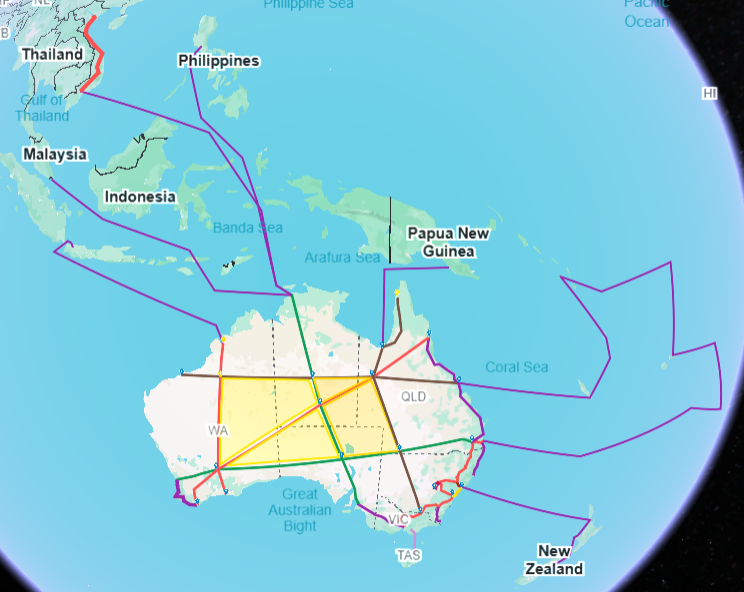
Cons of the current system & plan
Raw ore exports, finished goods imports
Australia ships iron, copper, bauxite, and lithium offshore as raw ore and imports finished steel, transmission line, motors, and batteries back. Value capture sits offshore; manufacturing capacity continues to atrophy at home.
Depleting export base
Coal, iron, LNG — the current export base depletes the resources it sells. Every tonne shipped is a tonne gone. Revenue ends when the resource ends; the economy has no perpetual export engine.
No regional grid integration
Australia sits at the edge of the Asia-Pacific with no infrastructure binding it to its neighbours. The trade relationship is transactional commodity exports; no shared infrastructure creates the mutual stake that makes integration durable.
Decarbonisation contribution capped at the border
Australia’s emission reductions stop at the Australian border. The country’s exceptional renewable resource is used domestically while regional neighbours run on imported coal. The global decarbonisation impact of Australia’s clean-energy potential is severely under-realised.
Strategic bifurcation, not integration
Without shared infrastructure, the region drifts toward strategic alignment blocs rather than economic integration. The European-Union pattern of conflict-suppressing interdependence is not built. Australian security depends on alliances rather than on regional mutual interest.
Export industry concentrated in a few firms
Resource exports flow through a small number of multinational firms with limited national accountability. Profits offshore via transfer pricing; royalties are negotiable; the economic uplift to ordinary Australians from the export base is much smaller than the resource value would justify.
Pros of the MMA plan
Regional grid construction industry
Australian shipyards and manufacturers build the cable-laying vessels, pipeline ships, subsea transformers, fibre cable, and structural components that connect the Asia-Pacific grid. The construction is itself a major Australian export — Australia as the regional infrastructure contractor.
HVDC electricity export to the region
Sovereign continental solar generates surplus at scale; HVDC subsea cables to Indonesia, Singapore, and beyond deliver Australian clean power to where it is needed. SunCable and its successors as the precedent. Revenue per MWh, every hour the cable runs.
AI compute and data export
Australian data centres on sovereign renewable electricity, with desert geothermal cooling, subsea fibre interconnects, 23 ms to Singapore. Australia positioned as the regional AI compute supplier the Indo-Pacific is looking for.
Critical minerals processed onshore
Iron, copper, bauxite, lithium, and rare earths processed and refined in Australia under Sovereign Defence Manufacturing rather than exported as raw concentrate. Value retention onshore; supply-chain security for regional partners on long-duration contracts.
Decarbonising the region by export
Every TWh of Australian renewable electricity exported displaces coal or gas generation in the importing country. Australia exports its emission reductions to the region — the largest single decarbonisation contribution any single country can make.
Two-way integration — PNG gas, regional water and fibre
Integration runs in both directions. PNG gas imports balance Australian exports of power, compute, and minerals. Water and fibre extend to selected regional partners. Mutual flows create mutual stake — the European-Union pattern of integration deep enough that conflict becomes structurally unattractive.
Renewable export revenue, perpetually
Unlike coal, iron, and LNG, these exports do not deplete. Every cable, every megawatt-hour, every contract renewed — perpetual revenue for Australians as long as the infrastructure runs.