Whose Future Are We Funding?
On 9 July 2026 AustralianSuper committed another A$500 million to build India’s infrastructure. More than half of Australia’s A$4.4 trillion retirement pool now sits offshore — funding America’s toll roads, Britain’s housing and India’s growth. This memo asks the obvious question: why isn’t our own money building our own nation — and what would it take to bring it home?
1. The trigger: another half-billion, sent to India
On 9 July 2026, during Prime Minister Modi’s visit to Melbourne, AustralianSuper — the country’s largest fund, with around A$410 billion under management — announced a further A$500 million into India’s National Investment and Infrastructure Fund (NIIF), the vehicle New Delhi created to pull global capital into its roads, ports and power. It follows an initial A$240 million in 2019 that the fund calls one of its best-performing infrastructure bets, and it lifts AustralianSuper’s total India holdings to A$3.3 billion across infrastructure, equities and private markets. The fund’s reasoning is candid and, on its own terms, correct: strong growth, sound policy, good returns for members. India gets long-term capital to build a nation. The question is why Australian workers’ savings are building India’s nation and not their own.
Today’s commitment is one marker in a much larger wave. Fresh pledges of Australian capital — to India’s infrastructure and data centres, to America’s AI campuses, to Britain’s housing and airports — are announced almost every time leaders meet, tens of billions of dollars at a time. So the questions this memo puts are simple ones about the money itself: where does it sit now, and where has it been promised next — and why is so little of it bound for home?
2. The pattern: the money has already left
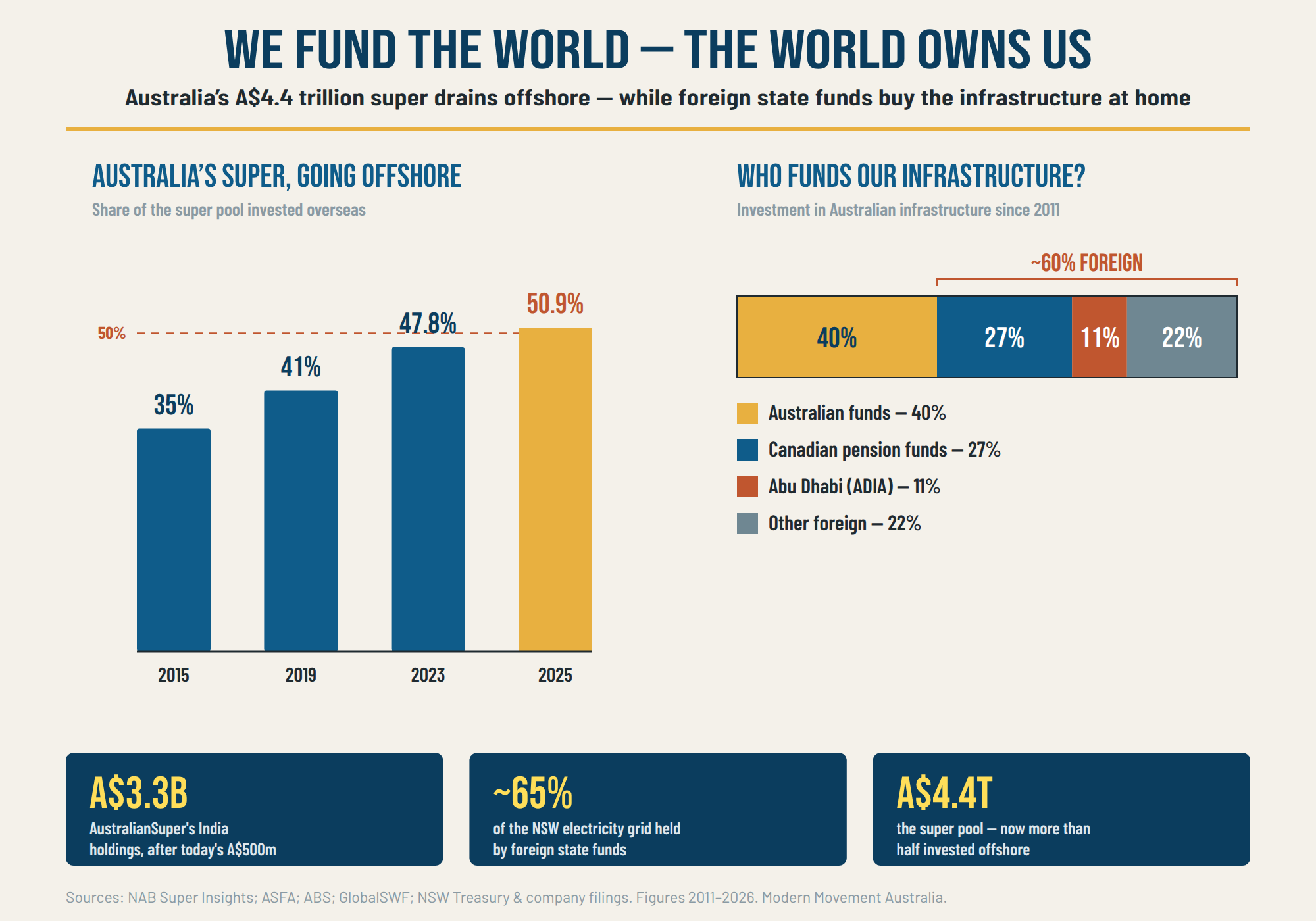
India is one line in a much larger ledger. By 2025 the share of Australia’s super invested internationally passed 50% for the first time (50.9%, on NAB’s industry survey) — up from 47.8% in 2023, 41% in 2019 and around 35% a decade ago. The United States takes the lion’s share (about 61% of listed international exposure), then Europe, then a sliver to China and the emerging world. The offshore assets are exactly the nation-building ones you would want here: US data centres, the Indiana Toll Road, Freeport LNG, Vienna and Heathrow airports, a controlling stake in London’s King’s Cross estate, thousands of new British homes. Super funds now own roughly a quarter of the entire ASX, up from 13% in 2005, and have supplied more than 60% of the nation’s net overseas share purchases in five of the past seven years. The trend is one-directional: most funds intend to send more offshore, not less.
3. Why it leaves — and why the funds aren’t the villains
It would be easy, and wrong, to blame the funds. A trustee’s legal duty is to get the best risk-adjusted return for members, full stop — and offshore diversification genuinely does that for a pool this size. The deeper reason is structural, and every fund chief says it plainly: Australia’s super is growing faster than Australia has places to put it. The ASX is dominated by banks and miners and is close to saturated; the domestic market is small; annual contributions now exceed what the local economy can absorb without distorting prices. So the capital goes where the large, long-life, investable projects are — and today those projects are in India, America and Britain, not here. Forcing the money home into a thin pipeline of mediocre deals would breach the funds’ duty to members and it would not build much. The problem is not the funds. The problem is that Australia has stopped building things big enough to invest in.
Funds will point, rightly, to diversification — no trustee should stake a nation’s retirement on one economy, and returns can be measured on both sides of the ledger. All true. But diversification is a reason to invest some money abroad; it is not a reason to leave the water, the energy grid and the rail line unbuilt. You can hold Indian data centres and fund Australian infrastructure — the two are not in conflict. The honest question is not whether to diversify. It is whether the projects this country actually needs are being funded at all. Right now, they are not.
4. What it costs us
Every dollar of Australian super that builds an Indian port or a Texan LNG terminal is a dollar that did not build an Australian one — and the returns, the jobs, the supply chains and the strategic asset all land somewhere else. We are, in effect, using the forced savings of Australian workers to industrialise our trading partners while our own water security, energy grid, freight corridors and housing go under-built. Governments have noticed: the “Investing in Australia” push wants super into housing, the Future Made in Australia agenda is trying to manufacture domestic opportunities, and AustralianSuper has pledged around A$40 billion at home by 2030. But a pledge of tens of billions is a rounding error against a A$4.4 trillion pool that adds hundreds of billions a year and sends most of it overseas. Tinkering will not turn that tide. Only a genuinely large domestic pipeline will.
5. They own ours; we fund theirs
Here is the mirror image, and it is the heart of the matter. While Australian super streams overseas, foreign sovereign and pension funds have been quietly buying the infrastructure at home — the long-life, inflation-linked, regulated assets our own funds fly around the world to find. The high-voltage backbone of the New South Wales grid, TransGrid, was leased for 99 years to a consortium in which Canada’s CDPQ, Abu Dhabi’s ADIA and Kuwait’s investment authority took the controlling share (Canada’s OMERS has since absorbed the Kuwaiti stake); the distributor Endeavour Energy went a similar way, with the Qatar Investment Authority among its owners. Canada’s OMERS alone has deployed around A$4 billion across Australian grids and the Port of Melbourne. Across the board, foreign state and pension funds have supplied roughly 60% of the investment in Australian infrastructure since 2011 — Canadian funds about 27%, Abu Dhabi 11% — while Australian funds put up barely 40%. Australians pay the power bills and the tolls; the returns flow to retirees in Toronto, Abu Dhabi and Doha. It is the exact reverse of what a A$4.4 trillion domestic capital pool should produce.
The tell is that the door is guarded only selectively: a Chinese state bid for the big NSW distributor Ausgrid was blocked on security grounds, yet allied sovereign and pension funds acquire the same assets freely. And the sharpest irony sits with Canada, which has just stood up its own national wealth fund to underwrite nation-building at home — ports, mines, energy — while its pension funds bank steady returns owning ours. Canada builds at home and collects the tolls here. Australia does neither with its own savings.
6. The farm and the factory, too
It is not only the wires and the ports. By the government’s own register, about 50 million hectares — roughly 13% of Australia’s agricultural land — now carry some level of foreign ownership, a share that climbs every year. The largest holders are the United Kingdom (7.7 million ha), China (6.5 million ha) and Canada (4.9 million ha), out of 73 countries in all; in the Northern Territory more than a quarter of all farmland is foreign-held, and 12.7% of the nation’s water entitlements are foreign-owned too — the very water we need to grow.
The absurdity has a name this month: Rushy Lagoon, Tasmania’s largest farm — some 21,700 hectares that ran dairy, beef and cropping. In July 2026 the government approved its A$100 million-plus sale to a trust run by the UK’s largest forestry manager, Gresham House, to be converted out of food production into a carbon-and-timber plantation; the dairies were closed and the last of the herd shipped to the mainland. The detail that should stop everyone cold: roughly A$69 million of Australian taxpayers’ money, through the Clean Energy Finance Corporation, helped finance the foreign fund’s project. Tasmanian farmers asked the obvious question — why could a foreign fund outbid Australians at the table? — and the same question runs through this memo with one more twist: our own A$4.4 trillion super pool wasn’t at that table either. We had the capital to buy Tasmania’s biggest farm and keep it Australian and productive; instead we helped pay for someone else to take it.
The industries are further gone again. On analysis by The Australia Institute, the LNG export industry that sets our gas prices is around 95% foreign-owned — several of the biggest projects entirely so; the mining industry that digs up the nation’s wealth is roughly 90% foreign-owned, the “Big Australian” BHP and Rio Tinto both majority foreign-held; and the top twenty companies on the ASX average about 80% foreign ownership, with even the Commonwealth Bank near 81%. (These are broad measures that count all offshore shareholding, including through global index funds, so the precise figures are debated — but the direction is not.) Australians dig the ore, ship the gas, work the land and pay the bills; a large share of the profit boards a plane. The same logic that sends our super offshore has, over decades, sold the productive base itself.
7. The answer: build the nation worth investing in
So why don’t our own funds simply build it? They can — and where the chance exists, they do: IFM and AustralianSuper won the Ausgrid auction, and Australian funds still put up about 40% of all infrastructure investment here. The gap is not capacity; it is opportunity. Our grid, ports and toll roads became investable only the day governments sold them, in one-off auctions the highest bidder won — and a foreign fund could always write a bigger cheque or accept a thinner return. New nation-building, meanwhile, barely exists to fund: high-speed rail sat as a study for forty years; the water network still doesn’t exist. And the rules quietly point the money offshore. The lesson is the hinge of this whole argument: Australian super does not need to be forced home — it needs a home to come to.
This is where MMA’s programme and the super problem meet perfectly. A continental build — the water network (three channels south, storage at Alice Hub, gravity-fed to farms and towns), the energy and pumped-hydro backbone, the freight and export corridors, the ports and the industry they unlock — is exactly the asset class super funds are flying around the world to find: large-scale, long-life, inflation-linked, government-anchored infrastructure that pays steady returns for decades.
Consider the starkest example of all. Australia is the only large developed nation on earth without a single high-speed train — Japan, China, Europe, the UK, even Indonesia have them; forty years and a dozen studies later, we have none. The one line finally in planning, Newcastle to Sydney, would cut the trip from two and a half hours to about one, and its own business case promises a A$250 billion economic boost, 160,000 new homes and 99,000 jobs over fifty years — and it is explicitly looking for private capital through public-private partnerships. That is a textbook superannuation asset: vast, decades-long, government-anchored, inflation-linked, paid back by fares and rising land values. The very funds that own toll roads in Indiana and airports in Vienna could own this line — and the MMA corridor programme puts exactly this class of project, high-speed passenger and freight rail across the continent, on the table alongside the water and energy. The paybacks are not speculative — the government’s own numbers are already on the page.
And it is not only roads and dams: the AI and data-centre boom now being built across India and Asia runs on precisely what a continental build would give Australia — firm, cheap power and abundant water for cooling. Supply the energy and the water, and the data centres — and the super that funds them — can be built here. Do not dictate to the funds; that fails on both law and merit. Instead, give them somewhere worth going. Stand up the projects, structure them so they clear the funds’ return tests, and the same institutions writing A$500 million cheques to New Delhi will write far larger ones to build Australia — earning their members a return and leaving the asset, the jobs and the sovereignty at home. The full case is in Without MMA and The Prize.
8. What government could do
None of this is fixed by decree, and the crude version — ordering funds to hold a set percentage at home — would collide with a trustee’s duty to members and force savings into second-rate projects. The lever is to change the conditions, not dictate the choice:
- Build and de-risk the pipeline. Stand up the nation-building projects — rail, water, energy — as bankable public-private partnerships, with government sharing the early-stage risk, so funds choose them because they stack up on their own return tests.
- Fix the benchmark. The Your Future, Your Super performance test quietly rewards funds for hugging global indices and penalises lumpy domestic nation-building — reform it so building Australia is not scored as a mistake.
- Protect the essentials. Legislate that critical infrastructure — grid, ports, water — stays majority Australian-owned, and buy back what is strategic, exactly as the Future Fund did in taking a slice of TransGrid back off a Canadian pension fund.
Legislation already shapes this market — the Foreign Investment Review Board decides who may own what, the super performance test steers allocations, and the Future Fund’s mandate was re-legislated to weigh national priorities. The rules are not neutral; they are simply not yet set to keep Australia’s wealth working for Australia. Done the right way, a fund’s duty to members stops being the obstacle and becomes the ally: good domestic projects are good for members.
Australian money belongs in Australian investments — building our own future, not everyone else’s.
9. The choice
Australia has done the hard part: we have amassed the capital. We have simply failed to build a country big enough to hold it, so it drains offshore to build everyone else’s. That is not a failure of the funds or of their members — it is a failure of national ambition. Bring the money home the only way that lasts: not by decree, but by building the nation worth investing in. Australian savings should build Australian infrastructure — the water, energy, corridors and industry of the MMA programme — because a country’s own retirement capital should fund its own future first. That is the whole argument: invest in Australia, for Australians.
Reinvest in Australia. Bring Australian super home.
Build the nation worth investing in — and keep our savings, our infrastructure and our land in Australian hands.
Sunshine Australia Party →References & sources
- AustralianSuper’s A$500m NIIF top-up and A$3.3bn India total (9 July 2026): AustralianSuper / NIIF statements and reporting (Financial Standard, Business Today, IANS), July 2026.
- Offshore allocation crossing 50.9% (2025), up from 47.8% (2023) / 41% (2019); US-dominant offshore exposure; funds’ ~25% ASX ownership: NAB Super Insights Report and ASFA analysis, 2025–26; ABS “Australia’s investment in overseas share markets” (2026).
- Total pool ~A$4.4 trillion (March 2026), ~150% of GDP, 4th-largest globally; structural drivers of the offshore shift: Deutsche Bank / Super Review (2025–26); Superannuation in Australia (overview).
- Fresh commitments of Australian capital to India (July 2026 Australia–India CEO Forum): reporting in Financial Standard, Business Today, Forbes and Reuters.
- Domestic-investment push and fund resistance to being directed: IFM “Investing in Australia” (2025); AustralianSuper A$40bn-by-2030 pledge (2025); Federal Budget 2026–27 “Future Made in Australia”. Interpretation and framing are the author’s.