The True Cost of "Cheap" Imported Fuel
It looked like economics while the tankers kept arriving — fuel bought cheap, no questions asked. Count the whole ledger and the verdict reverses.
Added the 2026 bill as it now stands: the import spend passing the nation’s entire LNG export income (§4, with a new chart), and the costs already sustained from international uncertainty alone — freight, war-risk insurance, re-routing and fuel queuing at anchor — itemised with sources (§5). New text is marked in blue.
Named the tax the nation collects on home production. The ledger now carries the tax base of an entire domestic fuel industry — company, payroll and income tax across its build and operating life — as its own line (§3), collected here rather than by a foreign treasury; and §4 sets out how the tax collected on domestic production partly recaptures the conceded higher price per litre, a return the import model has no way to make.
Added the public costs the per-litre comparison never counted: the standing Fuel Tax Credit (~$10 billion a year, the ledger in §3 and §4), the one-off 2026 crisis excise relief counted as forgone revenue, and the price-maker-versus-price-taker case for pricing control and shock-buffering through domestic production (§5).
Australia closed its refineries, sold its fleet, and ran its reserves down because importing fuel was cheaper per litre on a normal day. That price was correct, but it left out most of the costs: the reserves the country now has to hold, the freight and insurance, the roughly $59 billion a year (2023) that leaves the country, and the cost of a supply shock like 2026. This memo adds up those costs. Counted in full, importing is the expensive option. Producing fuel at home costs more upfront, keeps the money in the country, removes the risk, and builds an industry — and the same capability lets the country defend itself.
1. The decision, and the one number behind it
Between 2014 and 2021, Australia closed most of its oil refineries — Kurnell, Clyde, Bulwer Island, Altona, and finally Kwinana, the largest in the country. Over the same years it let its merchant fleet shrink to almost nothing and allowed its emergency fuel reserve to sit, year after year, below the level it had promised the world it would hold.
Each decision was defended with the same argument, and in its own terms the argument was sound. Australia's refineries were old and sub-scale; on the delivered cost of a litre under normal conditions, imports won. Keeping an Australian-flagged ship at sea cost more than chartering a foreign one. Holding a litre in a tank cost more than not holding it. On a calm day, every one of those numbers favoured the cheaper path, and the country took it.
The companies said as much at the time. Closing Kwinana — the largest refinery in the country — BP stated that the growth of large-scale, export-oriented refineries across Asia and the Middle East had structurally changed the market, and that "regional oversupply and sustained low refining margins" left the plant no longer economically viable; its Australia head added that the decision was "not in any way a result of local policy settings." ExxonMobil closed Altona, the smallest, as "no longer economically viable" after a review. Ampol's Lytton refinery lost $145 million in 2020 on depressed regional margins. The federal government summarised the Kwinana closure as based on "commercial and international factors, including the age of the refinery and overseas competition." Every reason given was a per-litre, single-firm margin reason. None of them weighed the cost to the nation of importing the lot — because that was nobody's job to weigh.
This memo does not dispute those commercial facts. The plants really were beaten on margin. The point is narrower: the firms optimised their own books, correctly, and no one ran the national ledger at all.
2. One number, doing the work of many
The price of a litre at the dock tells you what the fuel costs to buy. It tells you nothing about what it costs to keep that fuel arriving: the reserves the country has to hold, the shipping, the insurance, and the bill that lands when the supply is cut.
For a household filling up, the per-litre price is the whole decision — and rightly so. For a country deciding whether to make its own fuel or import all of it, that price is one number among many. Australia decided on the one number and left the rest out.
Set those costs side by side — importing versus producing here — and the picture changes. That is the comparison this memo runs, section by section, and pulls together in the ledger that follows.
3. The ledger
| Factor | Importing it (the status quo) | Producing it here |
|---|---|---|
| — COST — | ||
| Headline price per litre, calm day | Lowest — the number the closures were judged on | Higher today (conceded) |
| Annual spend, and where it goes | ~$59bn in 2023 (and rising) leaves the country, permanently | The same spend stays onshore and recirculates |
| Public fuel-tax credits | ~$10bn/yr (2024–25) and rising — excise refunded on mostly imported diesel | The same money would back domestic fuel and jobs |
| Economic multiplier | ~Nil here — margin, wages, tax compound offshore | Wages → spending → tax compound at home |
| Reserve to hold | Must buy a stockpile (the $3.2bn tank, inside the $14.8bn package) | Far less to hold — the resource is the reserve |
| Security margin (90-day obligation) | Buy the whole margin as a standalone asset — $3.2bn reaches only 50 days; ~$20bn+ more to reach 90, then yearly holding cost | Carried inside domestic production; never separately bought |
| Inflation pass-through | Imported inflation, currency-multiplied | Domestic, AUD-priced, insulated |
| — RISK — | ||
| Price volatility | Full world price, no buffer | Domestic buffer, stable |
| Currency (FX) | USD-priced; AUD falls in the same shocks — hit twice | AUD-priced; no FX exposure |
| Freight + war-risk insurance | Thousands of km; spikes thousands-fold in a crisis | None — made and used here |
| Shipping / fleet | Foreign ships; zero Australian-flagged fuel tankers | Minimal shipping; sovereign control |
| Chokepoint / supply chain | Hormuz + Asian refineries + tanker availability | Immune to chokepoints |
| Tail risk (the shock) | Priced at zero; ~3–5c/litre hidden premium (§5) | Falls as the import task shrinks |
| — NATIONAL BENEFIT (the column imports leave blank) — | ||
| Jobs | Offshore | Located here — construction, operations and regional activity, whoever fills the roles |
| Tax & royalties | Foreign refiners pay foreign tax | Royalties on any domestic feedstock, levied here |
| Company, payroll & income tax | The whole industry's tax base sits offshore | The tax base of an entire domestic fuel industry — build and operations — collected here, not overseas |
| Industrial capability | None retained; refining skills lost | Permanent sovereign capability — an asset |
| Resource base / options | Treated as irrelevant — "we have no oil" | False: a spectrum of sovereign options (§6) |
| Defence / strategic | Dependent, vulnerable, slow to fix | Plants, rail and refineries are themselves defence assets |
| — THE HONEST COSTS of producing here — | ||
| Upfront capital | None — you just buy | Real and large — refineries, exploration, electrification, backbone |
| Build time | Immediate | Years |
| Carbon | Refining emissions offshore = no Australian carbon cost | Safeguard ~$37/t onshore — but counted and reducible |
| Environmental trade-off | Hidden offshore | Clean path preferred; unconventional fallbacks contested |
Importing wins one row: the headline price on a normal day. It loses or leaves blank every other row. The one number Australia decided on is the only number that favours importing.
4. The cost that leaves, and the cost that builds
Two rows carry most of the weight, because they are about where the money goes.
Australia spent about $59 billion importing petroleum in 2023 — roughly $51 billion in refined product and $8 billion in crude. The figure moves with the oil price and the dollar, and the volume underneath it keeps rising, but it is tens of billions every year, and it leaves the country entirely. It pays the refining margin, the shipping, the insurance, and the wages of other nations. It lands in no Australian payroll, no Australian plant, and no Australian tax return. Spent, and gone.
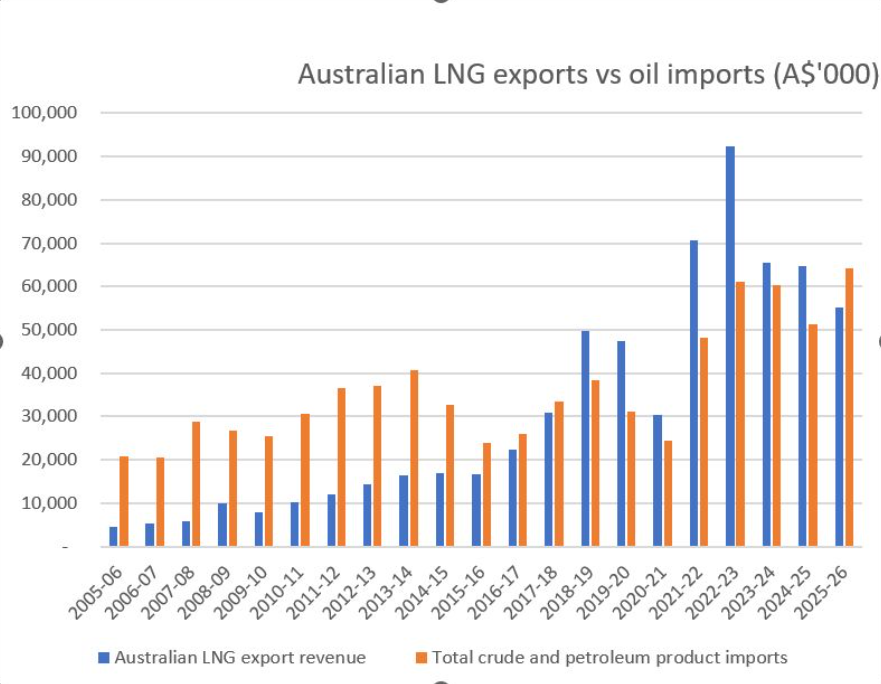
The bill has kept growing. On trade data compiled for this memo, the combined crude and petroleum product import bill reached about $64 billion in 2025–26 — and for the first time since 2020–21 it exceeded the nation’s entire LNG export income for the same year. The chart below puts the two lines side by side across two decades.
For most of the years to 2017–18 the fuel import bill ran ahead of LNG income; the LNG boom reversed that for a few years; the 2026 oil shock reversed it back. The country’s flagship energy export no longer pays for the fuel it buys in.
A dollar spent on domestic fuel buys the fuel and pays an Australian worker, an Australian supplier, and Australian tax. An imported dollar buys only the fuel; the wages, plant and tax go to the exporting country. Both deliver the litre. Only one builds anything here. That is what the per-litre price cannot show.
Some of that retained dollar returns to the public directly. An importer books its refining margin offshore and pays foreign company tax on it; a domestic producer earns the same margin here and is taxed here — company tax on the profit, payroll tax on the wages, royalties on the resource. These are not separate windfalls to be added up. They are slices of one thing: the value added by producing the fuel onshore instead of buying it made. That value-add is Australian GDP by definition, so producing here rather than importing relocates it into the domestic economy — not growth conjured from nowhere, but the same activity banked onshore instead of offshore. And the tax slice partly recaptures the one cost this ledger concedes. The domestic litre costs more at the pump; a share of that extra comes back as company tax, payroll tax and royalties the Commonwealth can spend here. Under the import model the margin leaves and none of it is recaptured. The per-litre price is the row importing wins — and it is exactly the row the tax take quietly claws back.
There is a second cost that only the importing country pays: the reserve. Because Australia makes almost none of its own fuel, it has to buy its entire security margin and store it, where a producing country carries that margin inside its own production for nothing. The obligation Australia signed up to as an IEA member is 90 days of cover. The country holds around 37, and the $3.2 billion reserve just funded reaches only about 50. Getting to 90 — the level Australia has been below since 2012 — means buying and storing on the order of six billion more litres of fuel: indicatively another twenty billion dollars and more in fuel and tankage, and then a permanent annual bill to insure, guard and cycle it so it does not degrade. That is the price of holding a margin you could otherwise keep in the ground. A producing nation never writes the cheque.
There is a third public cost the comparison never counted. To keep imported fuel affordable for the industries that run on it — mining, agriculture, heavy transport — the Commonwealth refunds the fuel excise back to those users through the Fuel Tax Credit scheme, at about $10 billion a year in 2024–25 and rising; the Budget’s own papers attribute the growth to rising use of eligible fuel, and mining alone takes close to half. Whether it counts as a subsidy is contested — the OECD and IEA classify it as one, the government and the industry reject the term — but the budget line is not in dispute. Under the import model almost all of it rebates tax on fuel bought overseas, and it pulls the wrong way twice: billions a year of public money underwriting imported fuel, while keeping that fuel cheap enough to blunt the case for the electrification that would end the dependency — by one large miner’s own analysis, the credit roughly halves the return on converting a diesel fleet to electric.
5. The number nobody computed: the price of the shock
The cost of a disruption is its probability times its impact. The decision to import all the fuel never priced it — the risk was simply left out of the calculation.
In 2026 the impact term arrived. When the Strait of Hormuz closed, Australia — holding the thinnest fuel reserves in the developed world — watched diesel pass three dollars a litre, forecourts run dry, and officials model rationing if stocks fell toward ten days. The government's response was a $14.8 billion Strengthening Australia's Fuel Resilience Package — and it is worth reading what sits inside that single headline, because the components tell the story and they are parts of the total, not additions to it. Of the $14.8 billion: $7.5 billion is an underwriting facility that secured around 740 million litres (740 ML) of diesel and 150 million litres (150 ML) of jet fuel the market would not have delivered; $3.2 billion builds a permanent government reserve — the "big tank," lifting cover to 50 days from barely 21; and $2.9 billion halves the fuel excise and zeroes the heavy-vehicle road-user charge for three months. The reserve drawdown, the relaxed fuel standards and the rationing modelling sit alongside. Every dollar of it bought, borrowed, stored or discounted existing fuel — the $3.2 billion tank most of all, which Section 6 takes up. None of it made a litre.
Two of those line items deserve to be named for what they are. The $2.9 billion excise cut is not a spend — it is forgone revenue, tax the Treasury chose not to collect so the pump price would not climb further. It is distinct from the standing Fuel Tax Credit in Section 4: the credit is a permanent rebate of about $10 billion a year; this is a one-off surrender of revenue in a single crisis. Both are the same reflex — the public purse absorbing a price the country cannot otherwise control, and both are costs the per-litre comparison never counted.
And that reflex is the tell. Halving the excise is what price management looks like in a country that does not own its fuel: reactive, costly, and gone the moment it is switched off. A price-taker has no other lever. It imports at the world price, so every shock abroad and every fall in the dollar passes straight through to the bowser and into the cost of everything freight carries — the country imports its inflation along with its diesel. A nation that produces its own fuel, more so one that holds public ownership of the resource — as Malaysia, Indonesia and the Gulf producers do — has the standing option to steady or cap the domestic price, and its own supply absorbs a shock instead of transmitting it. It need not use that lever every day, and permanent blanket subsidies carry real fiscal costs of their own; the point is the capacity. Importing surrenders it. Producing keeps it — price control as an available tool, and a buffer against imported inflation, as a standing benefit rather than an emergency cheque.
Put even a modest annual probability on an event of that size and the number stops being abstract. Australia burns on the order of 50 billion litres of transport fuel a year. A shock costing the economy in the order of $15 billion, occurring just once a decade, works out to a hidden risk premium of roughly three to five cents on every litre imported across that ten-year span — money the per-litre comparison never charged, because the risk it created was left out of the price. (The range reflects the spread between the headline crisis cost and a stricter, unbundled figure; either way the premium is real and recurring.) The cheap litre was only ever cheap because nobody put that line in the ledger.
The shock is not only a cost. It is also a transfer. When the oil price spikes, Australia's oil producers — who export more than ninety per cent of what they pump — earn more, while Australian motorists pay more for the imported fuel that comes back. The same chokepoint that drained the country's pumps was a windfall for the companies extracting its oil for export. Across 2026 the six largest oil majors were projected to earn around ninety-four billion US dollars for the year, about thirty-seven million dollars a day above the year before, with executives describing the volatility itself as a trading opportunity. The profit and the pain landed on opposite sides of the same event.
By mid-2026 the risk premium had stopped being an estimate. It had an itemised bill — costs sustained from the uncertainty alone, while every cargo still arrived. Brent passed US$100 a barrel on 8 March and peaked near US$126, up roughly 65 per cent in ten days.
Freight repriced harder than the oil: Persian Gulf crude cargo rates were assessed up 461 per cent for the year by early March, daily earnings on the largest tankers rose several-fold, and ships rerouting around the Cape of Good Hope added ten to fourteen days a voyage.
Because marine fuel is priced globally, emergency bunker surcharges landed on every trade lane — including Australian routes that never go near the Gulf — and the suppliers who replaced Gulf-linked cargoes with Argentine and US Gulf Coast product paid longer voyages and higher freight to do it.
Insurance repriced the same way, and the reinsurance market itself says it will not fully reprice back. War-risk cover for a single Gulf transit ran at 0.15 to 0.25 per cent of a ship’s hull value before the crisis, touched five per cent at the peak, and settled near one per cent.
Even the settled rate is several times the old one. Broker analysis of the 2026 losses — at least seven tankers hit, on the order of US$1.75 billion in industry losses before cargo — describes the Red Sea and Hormuz years together as a permanent structural repricing of marine war risk: a new baseline, not a spike. Every one of those costs is levied per litre carried, and Australia carries nearly every litre it burns.
Some of the fuel then paid to wait. Through mid-2026, laden tankers sat at anchor off Australian ports for weeks against a normal turnaround of two to three days — one product tanker waited some eight weeks off Wollongong before discharging, and by August roughly 670 million litres of the nation’s reported diesel stock was estimated to be afloat in the exclusive economic zone rather than in a tank on shore.
Idle chartered tankers bill by the day, and fuel counted in the headline “days of supply” while it rides at anchor is a reserve the country is paying freight on but cannot yet pump. In the same quarter the dependence itself set a record: 16,492 megalitres of petroleum imported in October–December 2025, the largest quarterly import in the country’s history.
None of these costs required a blockade of Australia. No shortage occurred; every cargo landed. This is what the import path charges for uncertainty alone — and on the insurers’ own assessment, part of that charge is now permanent. A country that produced its fuel would have paid almost none of it.
6. The reserve we already have, and the oil we are told we don't
Two objections have to be met, because the whole import case rests on them.
"We have to stockpile, and that's expensive." It is — but a built stockpile is the worst form of reserve. The $14.8 billion tank costs billions to fill, costs money every year to store, insure, and cycle, degrades because fuel does not keep, and drains: once you start drawing it down, the clock runs and nothing sits behind it. It is a depreciating asset you pay to hold and hope never to use. A reserve in the ground is the opposite on every count. Coal, gas, shale, and a standing canola crop cost nothing to "store," cannot be sunk or embargoed or turned back at sea, sit dispersed across the continent rather than concentrated in tank farms that are themselves a target, and never empty — you draw on them by producing, and the canola replenishes every harvest while the coal and gas are measured in centuries. A tank is a bucket. A resource is a tap. The country is spending billions to hold a worse version of a reserve it already owns.
"Australia doesn't have the oil." This confuses no cheap conventional oil at today's price with no resource. Australia holds some of the world's largest coal reserves, vast gas, and significant undeveloped shale basins. The technology to turn those into liquid fuel is proven and running commercially elsewhere: coal-to-liquids has fuelled much of South Africa's economy for decades, gas-to-liquids operates at scale in Qatar, and tight-oil fracking made the United States the world's largest oil producer. Australia has not developed these because, on a calm-day per-litre basis, importing was cheaper — the same incomplete number, again. The constraint is not geology. It is choice.
And the country has barely looked. Dorado, off the Pilbara coast in the lightly drilled Bedout Sub-basin, was the largest oil discovery in Western Australia this century — found in 2018 by a well that was chasing gas, in a basin that had seen around seventeen exploration wells against more than fifteen hundred in the basin next door. It is light, low-emission crude, headed for first oil around 2026 at up to 100,000 barrels a day, and on the operator's figures it pays back its build cost inside roughly a year. Dorado is not a lone hit: the same sub-basin holds a string of further oil and gas discoveries and leads — Pavo, Apus, Roc and others — and remains, on the explorers' own assessment, one of the most prospective and least-drilled petroleum provinces in the country. The Great Australian Bight, opened and then abandoned by the majors, is essentially untested. A nation that finds its biggest oil field in decades almost by accident, in a basin it had hardly drilled, has not run out of oil — it has stopped looking for it. The first step is to start: a serious, sovereign exploration effort across the frontier basins, begun without delay.
These options are not equal, and the honest path says so. The cleanest and best is to electrify the bulk of demand and make the residual from renewables and the nation's own biomass — sovereign and low-emission. Coal-to-liquids and shale are higher-emission and contested, and they are the fallback, not the plan. But their existence settles the point that matters: a nation that can make fuel from coal, gas, shale, sun, wind, and its own canola crop does not lack options. It lacks the decision to use them.
7. The honest other side
A full-cost case is worthless if it ignores what the import case gets right, so let it be said plainly. The refineries really were uncompetitive. Reopening them would not fix the dependency, and not only because they run on imported crude: Australia's legacy plants were engineered decades ago for light, sweet domestic crude, while the global slate has shifted heavier and more sour, so the surviving refineries are configured for feedstock the country no longer produces in quantity and must import to suit. "Reopen the old gates" is therefore a fantasy twice over — the plants are uncompetitive and mismatched to today's crude. That is exactly why the viable domestic path is not old-style refining but a structural pivot to converting the resources Australia does have: electrify the demand, and make the residual from biomass, gas and renewable power. Domestic fuel of that kind costs more per litre today, and not every litre can be replaced quickly; the domestic path carries real upfront capital and real build time, measured in years.
The pivot also does not mean rebuilding a refinery on the old scale. The choice was never a quarter-million-barrel mega-plant or nothing. Modular refineries — skid-mounted process units built in a factory and bolted together on site — reach completion in well under a year rather than five, at a fraction of the upfront capital, and scale in small increments. A simple topping or condensate-splitter configuration is matched to exactly the light condensate Australia produces and currently exports, rather than the heavy imported crude the old plants were built for. They are honest about their limits: small refineries have weaker unit economics and a narrower product slate, so they are not cheaper per litre than an Asian mega-refinery. What they offer is speed, low upfront cost, flexibility, and a match to the crude the country actually has — built where the oil is, sized to it, and added to as demand requires.
Producing at home is not free. But the money builds something in the country and removes the risk. Importing does neither, at any price.
8. The comparison, run properly — and what it builds
Run the ledger with every column filled, and the result inverts. The import path is cheapest on the one calm-day number and dearer on all of them once you count the outflow, the risk, and the benefit foregone. The production path costs more upfront and returns that spend to the country, builds an industry, and retires the risk. Over a decade, the investment pays itself back twice — in money that stays home instead of leaving, and in crises that do not happen.
And the spending does not buy fuel alone. The same capital builds refineries and processing, opens exploration, stands up a biodiesel industry across regional Australia, electrifies the freight task, and lays the corridor backbone — onshore, now, employing Australians. This is not an expense to be minimised. It is a New Deal to be kick-started: the moment a nation turns a permanent loss into permanent capability.
It is also defence. A country that can fuel and move itself can defend itself; one that imports nine litres in ten and owns none of the ships cannot. The fuel plant, the refinery, the electrified line, and the reserve in the ground are strategic assets. The comparison with the submarine program is direct. As set out in the companion memo The AUKUS Cost Blowout, that program is costed in the hundreds of billions over its life, with boats arriving through the 2040s. At about $59 billion in 2023 and rising, a single decade of imported fuel runs to $500–600 billion or more — more than the entire lifetime cost of the submarines — and it is spent every year, offshore, building nothing here. The same money put into fuel and energy capability secures the industrial base now, not in the 2040s.
9. The decision rule
The lesson is not really about fuel. It is about how a nation should evaluate any choice between making something and importing it: not on the price of the thing on a calm day, but on the total system cost and the total national benefit — the reserves, the volatility, the leakage, the tail risk, and what gets built or lost at home.
Australia was warned. The risk of import dependence was flagged in national security assessments in 2009 and 2011; a refinery-loss supply shock was modelled in 2011; a parliamentary committee asked for a fuel-security review in 2018; an interim review was published in 2019 and the final report was never released. Across that decade and a half, under both major parties, the refineries closed, the fleet was sold, and the reserve stayed below the line. The warnings were not missing. The full-cost analysis was.
How a country talks itself into this is not a mystery. Three forces pushed the same way. Decisions were made on narrow financial measures — the delivered cost of a litre, the return on a plant, the next result — by firms and treasuries each optimising its own books, with no one accountable for the national whole; every closure was locally rational and nationally costly. A carbon policy added to it: it priced the two domestic refineries for the emissions they produced onshore, while the imported litre's emissions, made in Singapore or Korea, carried no Australian cost at all — so it raised the cost of producing here and moved the emissions offshore rather than cutting them. And the working assumption underneath all of it was that demand would fall and imports would always be there. Britain made the same choices on the same logic, closed most of its refineries, and ended up just as exposed. None of the three forces set out to hollow out the country's fuel supply. Together, and accountable to no one for the sum, that is what they did.
A bigger reserve, a few new ships, and eight submarines each buy time. None of them fixes the dependency, and none of them builds anything in the country. Producing what we use does both. The number that closed the refineries was never the full number. The full number says build it here.
References
- Refinery closures and timeline — Australian Petroleum Statistics (DCCEEW/Department of Industry); Liquid Fuel Security Review interim report, April 2019.
- Stated reasons for closure (companies’ own words) — BP media statement on Kwinana, 30 October 2020 ("regional oversupply and sustained low refining margins… no longer economically viable"; "not in any way a result of local policy settings"); ExxonMobil statement on Altona, February 2021; Ampol 2020 results (Lytton loss of $145m); Minister for Energy media release on Kwinana, 2020 ("commercial and international factors, including the age of the refinery and overseas competition").
- Import dependence (~90% of refined product; ~71% of onshore-refined oil is imported crude) — Australian Petroleum Statistics; IEA.
- Annual petroleum import bill — ~A$59bn in 2023 (refined product ~A$51bn + crude ~A$8bn), price- and FX-dependent and rising with volume — DFAT trade statistics / Australian Petroleum Statistics (DCCEEW).
- Crude/condensate exports (~94–96% exported; A$13.2bn earnings, 2022–23) — Geoscience Australia, Australia's Energy Commodity Resources.
- 2026 crisis response — Budget 2026–27 fuel-security papers; ministerial releases (the $7.5bn Fuel and Fertiliser Security Facility; ~740ML diesel / ~150ML jet secured; excise halving and road-user-charge pause; ~20% reserve drawdown; $14.8bn resilience package).
- Reserve position (~37 days; high of 310 days in 2002; IEA 90-day obligation unmet since 2012; member average ~140) — IEA oil-stock data; DCCEEW; contemporary reporting, 2026.
- Carbon treatment — Safeguard Mechanism (DCCEEW): default price ~A$36.82/t (interim to March 2026); A$75/t ACCU price cap; applies to facilities over 100,000 t CO₂-e; government leakage review recommended a border carbon adjustment for import-exposed goods.
- Resource base and conversion technology — coal-to-liquids (Sasol, South Africa); gas-to-liquids (Shell Pearl, Qatar); tight/shale oil (US tight-oil production); Geoscience Australia resource assessments (Cooper, Canning, Beetaloo basins).
- Canola/biodiesel reserve (5.84Mt in storage ≈ 2.2bn L; ~34–37 days diesel) — MMP fuel-crisis letter series (Letter 7, 31 March 2026), drawing on ABARES crop data.
- Warnings timeline — National Energy Security Assessments 2009 and 2011; ACIL Tasman Liquid Fuels Vulnerability Assessment 2011; PJCIS recommendation 2018; Liquid Fuel Security Review interim report 2019 (final never released).
- Oil-producer windfall during the 2026 shock (six majors projected ~US$94bn for the year, ~US$37m/day above 2025; volatility as a trading opportunity) — Oxfam International analysis, 2026; Fortune; company Q1 2026 results.
- Modular/mini refineries (skid-mounted, <12 months to completion vs ~5 years, lower upfront capital, 1,000–40,000 b/d, topping/splitter suited to light condensate; weaker unit economics than mega-refineries) — industry sources (Honeywell UOP modular trains; Howe Baker; modular-refinery technical literature).
- UK refinery closures and import exposure — UK refining-capacity decline, parallel trajectory.
- LNG export revenue vs petroleum import bill (chart, §4) — ABS international trade in goods data, financial-year series compiled by Modern Movement Australia; 2025–26 import bill ~$64bn, exceeding LNG export income for the first time since 2020–21.
- 2026 freight and oil repricing (§5) — S&P Global Platts commodity tracker, 3 March 2026 (Persian Gulf crude cargo rates $62.07/mt, up 461% from the start of the year); IRU fuel analysis, March 2026 (Brent up ~65% between 27 February and 9 March, peak ~US$126); shipping-industry reporting on Cape of Good Hope re-routing (+3,500–4,000 nm, +10–14 days) and emergency bunker surcharges applied across all trade lanes including Australian routes; Australasian Convenience and Petroleum Marketers Association on replacement sourcing from Argentina and the US Gulf Coast at longer voyage times and higher freight (National Bulk Tanker Association panel, May 2026).
- War-risk insurance repricing (§5) — marine-insurance market reporting, 2026 (additional war-risk premium for a Hormuz transit 0.15–0.25% of hull value pre-crisis, peaks near 5%, easing to ~0.8–1%); Howden Re, Strait of Hormuz report, 26 March 2026 (at least seven tankers struck, ~US$1.75bn implied industry losses before cargo; Red Sea 2024–25 plus Hormuz 2026 assessed as a permanent structural repricing of marine war risk).
- Fuel afloat and waiting tankers (§5) — crudeoilpeak.info analysis of DCCEEW minimum-stockholding statistics, 1 August 2026 (~670 ML of reported diesel stock estimated offshore in the EEZ; the tanker GRAND WINNER 5 held ~8 weeks off Wollongong before discharge; a second product tanker waiting from 12 July against a 2–3 day norm); Australian Petroleum Statistics (record quarterly petroleum import of 16,492 ML, October–December 2025).